'Job forever': trade schools are all the rage in the AI era / Photo: ANGELA WEISS - AFP

Long looked down upon, skilled trades are booming in the United States, especially among young adults drawn by strong demand -- even as artificial intelligence (AI) eats into service-sector jobs.
"I think it's definitely shifting," said Nizier Lawrence, in his early twenties.
Prior to the pandemic, "people weren't really talking about going to trade school, vocational schools, stuff like that. It was like: 'Go to college, get your four years.'"
The New Yorker spent three years at Keuka College, a private school upstate, before changing plans. "I wanted a break," he remembers, partly because he was "homesick" for the city.
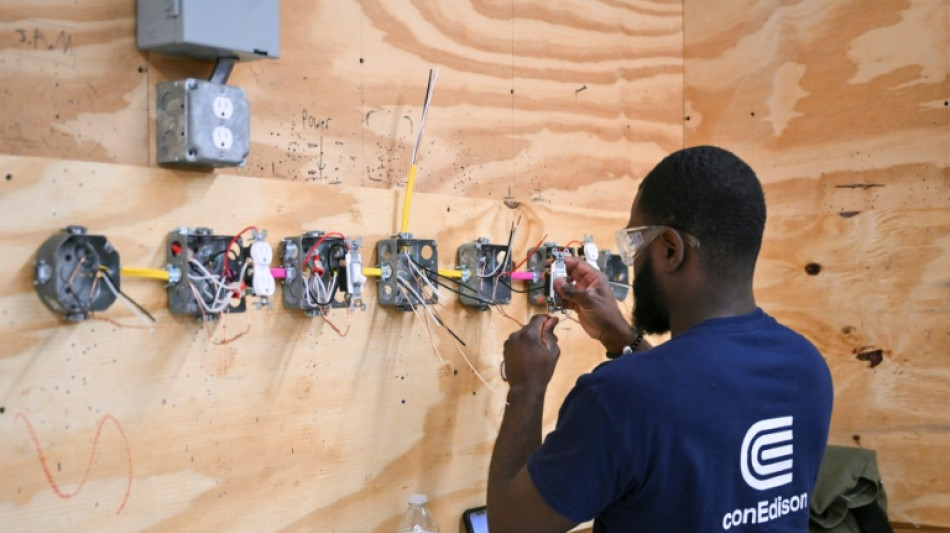
He subsequently enrolled at Apex Technical School in Manhattan to train as an electrician and hasn't looked back.
"I'm learning more in three weeks than I did in college in three years," he says.
- AI and job security -
Students here don't have much to say about AI, but they quickly turn to job security, reflecting a concern that stands in contrast with the US's low unemployment rate of roughly four percent.
Among 27- to 39-year-olds who use AI multiple times a week, only 22 percent believe their jobs are "safe from being eliminated," according to payroll group ADP's People at Work 2026 report.
"I think a lot of people should probably pivot towards trade," said Lawrence. "You'll have a job forever, you're gonna make a lot of money."
"They'll always need electricians," said Anthony Byrd, one of Lawrence's classmates. "Everything is powered by electricity right now. Without us, the whole world would probably fall apart."
The rise of AI has sparked a boom in data center construction, creating a need for numerous skilled tradespeople -- especially electricians.
Employment of electricians is projected to grow 9 percent from 2024 to 2034, much faster than the average for all occupations, according to a report from the Bureau of Labor Statistics released two years ago.
- 'Craving connectedness' -
The student body has been getting younger, with "a lot more students from the high schools" enrolling at Apex Technical School, said Zelda Cuesta, agency coordinator.
In the past, administrators "frowned upon trade schools, they wanted to steer everybody to go to college."
Now, "when I go to a high school, I'm a rock star," Cuesta said.
Many students point out that while the cost of training is significant -- totaling around $18,000 -- it is far less than the cost of university, which is estimated at over $38,000 per year in the United States, according to data website Education Data Initiative.
Not to mention that a university degree takes at least four years to complete, whereas Apex trains an electrician in seven months on average.
According to the Department of Labor, the average salary for an electrician surged by 55 percent between 2015 and 2025.
"When I do the tour and they come in to visit the school, I do reinforce AI is not going to be able to take over our jobs," Cuesta said.
"Buildings will still have pipes running through them, they'll still have wires running through them," she said.
Apex also trains plumbers, HVAC technicians, welders and cooks.
An advisor with the culinary program, Amy Quazza, thinks "we kind of drift back to tradition when things are untethered or feeling untethered," which explains the renewed appeal of old-economy trades.
Beyond the threat of AI, Cuesta connects this newfound popularity of manual trades to the pandemic and long periods of confinement.
Jaydon Negron, another one of Lawrence's classmates, remembers "being in Covid, and it was so depressing. And when it came to deciding (on higher education), I was like, hands-on work is definitely more my field, because I just can't stay still."
Lawrence praises the opportunity to "meet a lot of people" and foster connections.
Quazza sees a generation "really craving that connectedness...and that's what draws many people to the kitchen."
B.Lenz--BVZ