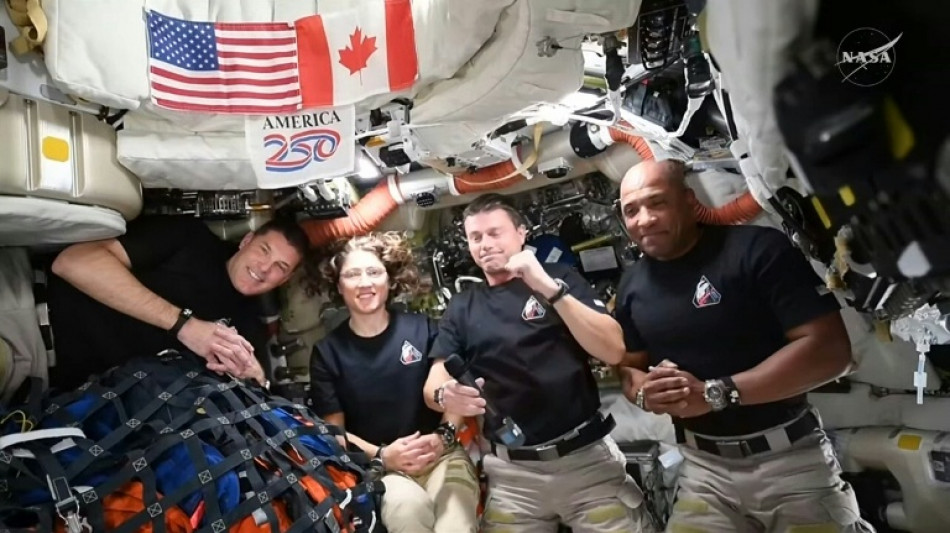
After milestone-rich lunar flyby, astronauts start trip home / Photo: Handout - NASA/AFP

Little-known lunar craters, a solar eclipse and meteor strikes: the Artemis II astronauts wrapped their lunar flyby and began their journey back to Earth late Monday, bringing with them rich celestial observations scientists hope will open doors.
Their eyes glued to the spacecraft windows for nearly seven hours, the team of four who spent their day breaking records and making history were treated to a view of the Moon unlike any other.
"Humans probably have not evolved to see what we're seeing," said Victor Glover. "It is truly hard to describe. It is amazing."
The crew reported in vivid detail features of the lunar surface and later witnessed a solar eclipse, when the Moon passed in front of the Sun.
They also described flashes of light -- meteor strikes -- on the Moon's surface.
"I can't say enough how much science we've already learned," Kelsey Young, lead scientist for the Artemis II mission, told the astronauts.
"You really brought the Moon closer for us today, and we cannot say thank you enough."
- Trump praises 'modern-day pioneers' -
But even after becoming the furthest humans to ever travel from Earth, their day was not over: the bleary-eyed astronauts remained in good spirits as they took a late-night call from US President Donald Trump.
Unlike the Artemis astronauts and NASA administrator Jared Isaacman, Trump at age 79 is old enough to remember the Apollo days.
And he was, in a word, impressed.
"You've really inspired the entire world," Trump said, calling them "modern-day pioneers" who have "a lot of courage doing what you're doing."
"America will be second to none in space and everything we're doing, and we will continue to lead the whole thing into the stars, this incredible journey into the stars."
He probed the astronauts about their favorite moments and asked what it was like to lose connection with Earth for some 40 minutes during an expected communications blackout.
The call even had a little signal glitch of its own, with Trump waiting expectantly as the astronauts appeared not to hear him for a full minute.
"Might have gotten cut off," Trump said. "It is a long distance, it's a long ways."
- A historic trip -
Monday's milestones were plentiful, including when the Artemis II team broke the distance record set by the 1970 Apollo 13 mission, which they were expected to surpass by 4,105 miles (6,606 kilometers) when they reached the journey's anticipated furthest distance from Earth -- 252,760 miles (406,778 kilometers).
Astronaut Jeremy Hansen said the moment should "challenge this generation and the next, to make sure this record is not long-lived."
And as noted by Trump, the crew lost contact with planet Earth for about 40 minutes as their spacecraft passed behind Earth's satellite.
The blackout period was expected but still notable: they were the first people in more than 50 years to lose contact with the rest of humanity.
"It is so great to hear from Earth again," said astronaut Christina Koch, as the crewmembers were once again able to speak with humans on their home planet.
"We will always choose Earth."
- Moon memorials -
The Orion capsule will now travel back to Earth in a so-called "free-return trajectory," a trip home that will take about four days.
Adding to the historic nature of the mission led by Reid Wiseman, the Artemis II crew includes several firsts.
Glover will be the first person of color to fly around the Moon, Koch will be the first woman, and Canadian Hansen the first non-American.
Monday's celestial workday included a poignant moment just after the crew broke the distance record, when they proposed designating two previously unnamed craters.
The first they requested to name in honor of their spacecraft's nickname, "Integrity."
They offered a second name, "Carroll," for another crater, which they asked be named after the late wife of mission commander Reid Wiseman, who died of cancer.
"It's a bright spot on the Moon," said Hansen, his voice breaking with emotion. "And we would like to call it Carroll."
The astronauts embraced, and mission control in Houston held a moment of silence.
"Integrity and Carroll crater, loud and clear. Thank you," said Gibbons.
NASA said they would formally submit the name proposals to the International Astronomical Union, the body charged with naming celestial bodies and surface features.
P.Baumann--BVZ