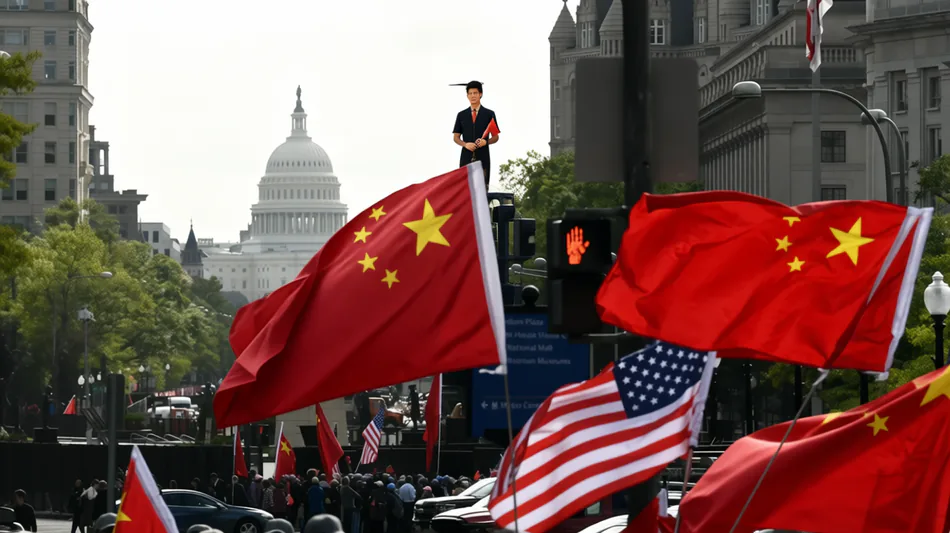
Chinese Dissident Yuanjun Tang Avoids Prison After Admitting to Spying for Beijing

A prominent member of New York’s Chinese dissident community who admitted to spying on his fellow activists for the Chinese government avoided prison time at his sentencing Thursday in Manhattan federal court. Yuanjun Tang, 69, was sentenced to three years’ probation by Judge John G. Koeltl after pleading guilty to failing to register as an agent of the People’s Republic of China.
A prominent member of New York’s Chinese dissident community who admitted to spying on his fellow activists for the Chinese government avoided prison time at his sentencing Thursday in Manhattan federal court.
Yuanjun Tang, 69, was sentenced to three years’ probation by Judge John G. Koeltl after pleading guilty in September 2025 to a charge that he failed to register as an agent of the People’s Republic of China with the U.S. attorney general’s office. The maximum penalty for the offense was five years in prison.
Assistant U.S. Attorney Jane Chong had requested the five-year sentence, arguing that Tang’s actions inflicted lasting damage on a community of activists. However, Judge Koeltl noted that claims by some individuals who believe they and their families were targeted for harm because of Tang’s espionage could not be proven.
Tang, an outspoken critic of the Chinese Communist Party for over three decades, participated in the 1989 student-led Tiananmen Square demonstrations calling for democracy and political reform. He was imprisoned in China for 12 years for his involvement in those protests. In 2002, he defected to Taiwan and subsequently to the United States, where he was granted political asylum. He became a naturalized U.S. citizen in July 2018.
By the time of his citizenship, prosecutors said Tang was already providing information to China’s Ministry of State Security, the country’s principal civilian intelligence agency. Court documents indicate that at the direction of a Chinese intelligence officer, Tang agreed to photograph and record local protests against China. This included a 2023 event in Manhattan dedicated to victims of the Tiananmen Square massacre.
Tang’s cooperation with Chinese authorities began after he established himself in Flushing, Queens, where he has lived since 2002. He joined monthly protests outside China’s Manhattan consulate and founded a nonprofit organization, winning the trust of others in the pro-democracy movement. According to prosecutors, Tang provided information on dozens of individuals from at least 2018 to 2023. This included enabling a Chinese handler to join an online chat group titled “Friends of the Chinese Democracy Party,” which he had started with 140 Chinese-American individuals.
The FBI first met with Tang in June 2023, informing him that his phone likely contained malware planted by the People’s Republic of China. Prosecutors stated that Tang then confessed to carrying out tasks for the Ministry of State Security for years in return for approximately $4,200 annually.
Defense attorney Michael Bradley described Tang as a democracy advocate and writer who desperately wanted to return to China to visit his ailing parents and brother. Bradley said Tang made contact with an individual who claimed he could facilitate this trip. The lawyer stated that Tang did not realize the man was a spy until he arrived in China, by which time his mother and brother had already died.
Speaking through a Chinese interpreter, Tang told the judge that he betrayed his ideology to visit China and “see my parents again.”
“I deeply regret my actions,” Tang said. “My actions have caused a certain harm to other people.”
Tang’s October 2024 arrest followed several high-profile investigations into China’s attempts to harass and silence dissidents abroad, part of what federal officials have termed a campaign of “transnational repression.” Chong argued that Tang’s betrayal of those who joined him in the protest movement furthered this ongoing story.
“His actions had a chilling effect on an entire community of people,” Chong said. She added that his espionage enabled Chinese authorities to monitor and intimidate activists, stating, “They can never stop looking over their shoulders.”
Four individuals who believe they were victimized by Tang’s spying spoke at the sentencing. Several stated they believed the deaths of family members in China were suspicious after their activities in the U.S. were exposed. One man said he did not believe his stabbing in the throat with a knife was a random attack.
Judge Koeltl acknowledged the gravity of the case but found that the specific harms alleged by some victims could not be substantiated to the standard required for a prison sentence. The probation term includes supervision and potential restrictions on future contact with foreign intelligence entities.
S.Pfeiffer--BVZ