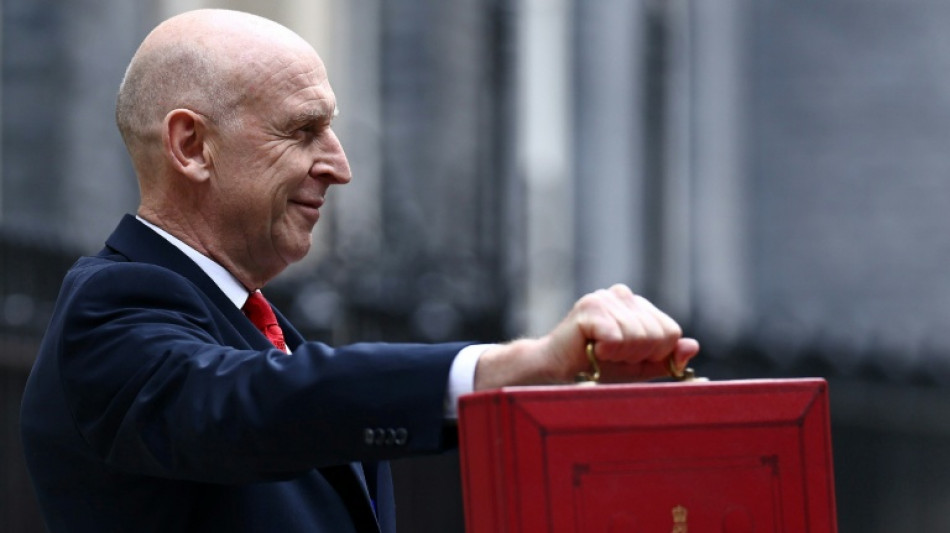
UK budget lifts bank tax to offset surging energy bills / Photo: Henry NICHOLLS - AFP

Britain's Labour government will increase a tax on profits earned by banks to help fund support for soaring energy bills, finance minister John Healey said in his budget announcement Wednesday.
The first budget of Prime Minister Andy Burnham's new administration was delivered against a harsh global backdrop of rising inflation and borrowing costs.
However Healey pledged to raise defence spending to three percent of GDP by 2030, a commitment he had pushed for as defence secretary under PM Keir Starmer before resigning over insufficient military funding.
Britain's economy will grow slightly faster than forecast this year before slowing sharply in 2027, driven by the fallout from the war in the Middle East, Healey said Wednesday as he delivered the government's annual budget.
"Fiscal discipline is my first commitment," said Healey, as he faced pressure to reassure Britain's bond market.
Healey, whose official title is chancellor of the exchequer, promised "immediate" support for households and businesses in the face of "global economic storms".
The Labour government will double a surcharge on profits earned by banks operating in the country -- to six percent -- to finance a one-off subsidy to millions of households struggling with higher energy costs.
The government will hand out a direct payment of £100 ($133) to 20 million households, as gas and electricity prices surge in large part owing to the Middle East conflict.
Further measures to lower household bills included removing fixed fees on gas bills, while extending a freeze on fuel duty.
Healey was constrained in his spending plans by a commitment to abide by the rules laid out by his predecessor Rachel Reeves, which state that day-to-day spending must balance with government tax receipts.
- Growth downgrade -
However GDP would slow to 1.0 percent next year after Labour had forecast 2027 output growth of 1.6 percent in early March, he told parliament.
The government relies on the Office for Budget Responsibility, an independent fiscal watchdog, for its estimates.
The International Monetary Fund earlier this month also upgraded its 2026 forecast for UK GDP while downgrading its outlook for next year.
It comes after Britain's economy grew more than initially estimated in the second quarter, by 0.5 percent, according to official data.
The Bank of England will update its own forecasts for the UK economy on November 5, alongside an expected hike to its benchmark interest rate as inflation stays high.
The government's fiscal headroom will meanwhile be slashed to £15 billion in the 2029-2030 period, compared with £23.6 billion in March, as higher borrowing costs hike the state's debt repayments.
Government bond yields around the world have struck multi-decade highs in recent weeks as wider inflation climbs largely because of energy prices soaring on wars in the Middle East and Ukraine.
- Defence spending -
The chancellor delayed until next year details of how Britain will meet NATO's target of defence spending reaching 3.5 percent of GDP by 2035.
But NATO Secretary General Mark Rutte welcomed the 3.0-percent pledge, saying in a post on X: "Good news on the new budget... with a strong commitment on defence."
An increase in the minimum wage by 3.9 percent and support for first time homebuyers was also announced in the latest tax and spending plans.
Some relatively low-cost relief measures for households were announced ahead of the budget, including tariffs cuts to certain imported goods like gherkins and marmalade, along with measures to reduce "pointless paperwork" for businesses.
A package of investment in artificial intelligence safety was announced by the Treasury over the weekend, amid growing global concerns over the cyber and biological risks posed by AI.
A.Huber--BVZ