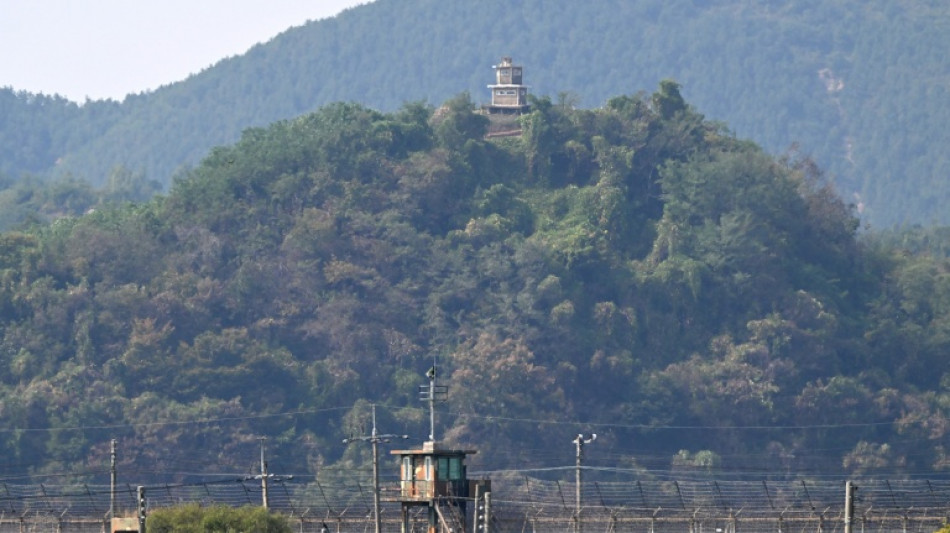
North Korea demands South show 'utmost respect' to restore relations / Photo: Jung Yeon-je - AFP

The powerful sister of North Korea's leader said Thursday that Seoul must show the "utmost respect" to mend ties, after Pyongyang denied responsibility for a DMZ mine blast that wounded South Korean soldiers.
North Korea has rejected claims it was behind the explosion that injured three soldiers last month inside the Demilitarised Zone (DMZ), the heavily mined buffer area that has divided the two Koreas since their 1953 armistice.
A joint Seoul-United Nations Command investigation concluded the blast was caused by North Korean mines laid on the South Korean side of the border.
South Korea's military demanded an official apology last week, accusing Pyongyang of "a clear violation of the Armistice Agreement", while Seoul's civilian leadership called for the North to return to dialogue.
"If they (Seoul) really want to reverse the relations between the DPRK and the ROK, they should be conscious of their rival's feelings in every word and action and show their utmost respect, solicitude and sincerity before anything," North Korea's Kim Yo Jong said Thursday, using the two countries official acronyms.
On Wednesday, a government report revealed Seoul had secured a UN sanctions exemption to send medical equipment next month to North Korea, which has long suffered poor healthcare infrastructure.
Analysts say the move would allow Seoul to provide North Korea with humanitarian aid including ambulances and medical sterilisation tools.
The North has long been criticised for prioritising the military over adequately providing for its people.
Elizabeth Salmon, UN special rapporteur on human rights in North Korea, said this year that food shortages remained a key humanitarian concern in the country.
Government sources said the aid programme is worth around 9.3 billion won ($6.95 million) in total.
But Kim Yo Jong, whose brother is North Korean leader Kim Jong Un, said the aid was Seoul's attempt to pivot from what she called a "self-orchestrated farce" that had failed to get the response it was seeking.
"There are two doubts whether they are political immature guys or truly born idiots who can never be remodeled," Kim said.
-Unwelcome distraction-
North Korea's military has placed mines and built anti-tank barriers along the frontier as part of efforts to permanently seal it off following Kim Jong Un's designation of South Korea as his country's "principal enemy" in 2024.
The mines responsible for the blast last month were believed to have been laid over a year ago as part of Pyongyang's border fortification work, according to South Korea's defence minister Kang Shin-chul.
Kim Yo Jong previously ridiculed President Lee Jae Myung's latest overture for dialogue as "the climax of the farce that everyone should watch", while calling Seoul's demand for an apology "quite ridiculous".
Seoul's Unification Minister Chung Dong-young has also proposed to Pyongyang talks to address issues along the border.
But Kim Yo Jong said Thursday it was her country's "unshakable" position that North Korea has "nothing to exchange or go with the ROK (South Korea) and no need to (meet) face to face with it."
Any action by Seoul -- whether driven by "evil intention or good faith" -- will be "regarded as a challenge and grave provocation to the DPRK and a violation of its sovereignty," she added.
Kim's latest statement comes at a sensitive time, as US President Donald Trump's recent overtures to Pyongyang have raised concerns that Seoul -- an ally of Washington -- could be sidelined in potential nuclear talks involving the North.
Analysts say Kim's message could be read as a warning to Seoul to stay quiet on the landmine issue, with the North calculating that continued exchanges with the South could complicate its broader, global diplomatic agenda.
"Pyongyang's priority is not inter-Korean engagement but the possibility of a larger deal with Washington, while maintaining its increasingly close relationship with Russia. South Korean interventions are therefore seen as an unwelcome distraction -- or even an obstacle -- to that strategy," Ahn Chan-il, a researcher originally from North Korea, told AFP.
"At the same time, the warning could be interpreted as stopping short of completely foreclosing inter-Korean dialogue: essentially telling Seoul not to interfere unless it has something substantial to offer."
M.Voigt--BVZ