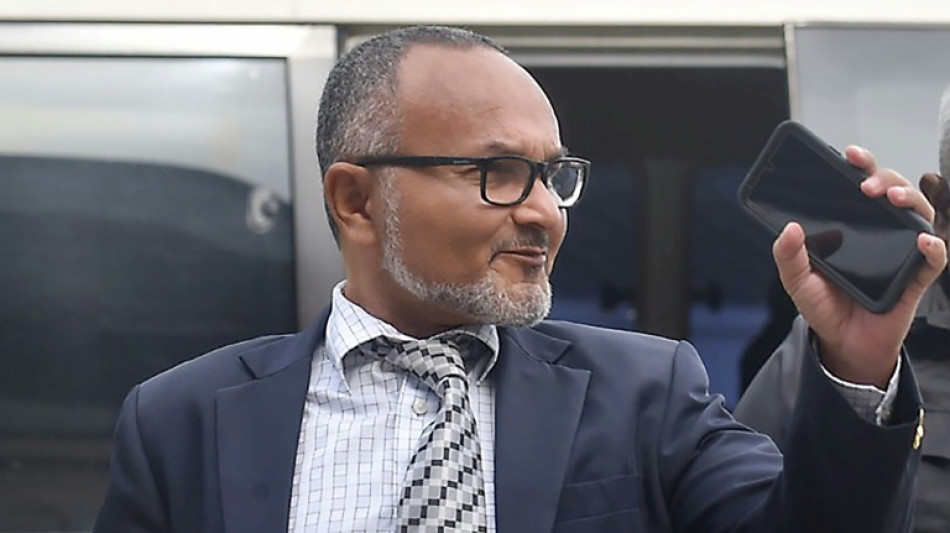
Solomon Islands elects opposition leader Matthew Wale as PM / Photo: Alarics FUGUI - AFP/File
The Solomon Islands on Friday elected as its new prime minister Matthew Wale, who has been a critic of the South Pacific nation's closeness to China and pledged to bring change.
The Solomon Islands has been seen as one of Beijing's closest Pacific islands partners in recent years and changes of leader in the strategically located archipelago are closely watched by Western diplomats.
Wale -- who leads the Solomon Islands Democratic Party -- won 26 votes in a secret ballot of 49 lawmakers, Governor General David Tiva Kapu announced on the steps of parliament.
The previous government's candidate, Peter Shanel Agovaka, won 22 votes, with one lawmaker absent and another ballot void.
Former prime minister Jeremiah Manele was ousted last week in a no confidence motion in parliament after a dozen ministers quit the government in March.
"Change is coming. These changes are necessary and may be painful," Wale, 57, told media outside parliament.
Wale said he was taking government at a difficult time "given what is happening throughout the world".
"We are not immune from these geopolitical events," he said, calling for Solomon Islanders to unite.
"I appeal to the youth of our country, be ambitious for yourself and be part of the growth we want to see in the Solomon Islands."
Opposition leader since 2019, when Solomons switched ties from Taiwan to China, Wale has campaigned for greater government transparency in dealings with foreign mining and logging businesses.
Despite its population of just 700,000, the Solomon Islands occupies a strategic position 1,600 kilometres (990 miles) northeast of Australia, a major aid donor that is critical of China's police presence in Honiara.
Australian Prime Minister Anthony Albanese wrote on social media that he looked forward to working with Wale and "strengthening our economic, development and security partnership".
- 'Outspoken against China' -
Wale, a former accountant, hails from Malaita, the most populous province whose local government boycotted Chinese companies until 2023.
Wale criticised then prime minister Manasseh Sogavare, who struck a secret security deal with China, for saying he was "back home" upon arriving in Beijing on a visit in 2023.
Anouk Ride, associate professor at the Australian National University, said Wale's election was "a seismic shift" in Solomons politics.
He was likely to be "more moderate" on China ties, and focussed on the national interest, education, policing and health, she told AFP.
Ordinary Solomon Islanders are struggling because of a surge in fuel prices brought on by the war in the Middle East and there had been little improvement to health and education in rural villages since a conflict destroyed many services 20 years ago.
"You can see this very visibly in the rural areas and also Honiara town where people are living without electricity and water supply," Ride said.
While the "geopolitical switch" to China brought large, visible developments including a national stadium and provincial airports, she said "those big-ticket projects haven't impacted the lives of people."
Australian National University Pacific affairs expert Graeme Smith said while Wale has been outspoken against China "it will be a tricky balancing act for him" as several of Wale's new coalition partners are close to Beijing.
Former Australian diplomat to the Solomon Islands James Batley said Wale was "pragmatic when it comes to international relations" and likely to continue to balance ties with China and Australia.
S.Dietrich--BVZ