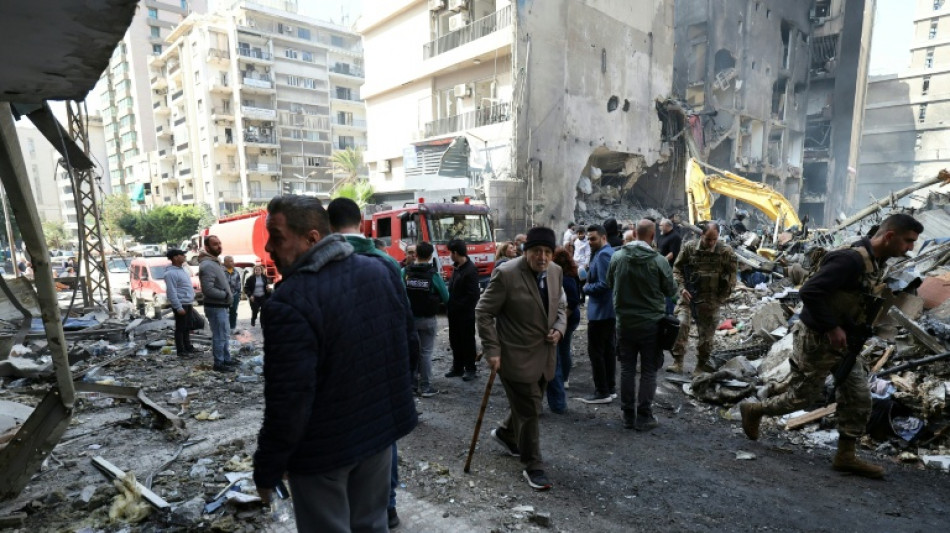
War-weary Lebanese weigh giving talks with Israel a chance / Photo: Ibrahim AMRO - AFP

From his small shop in Beirut, facing a building destroyed by an Israeli airstrike, Qassem Saad said he was exhausted by repeated Israeli wars on Lebanon, and hoped negotiations could end decades of suffering.
"We know that Israel will remain an enemy to us, but we are tired," 49-year-old Saad, who suffered a minor injury in the strike, told AFP.
A meeting is scheduled to be held Tuesday in Washington between the Lebanese and Israeli ambassadors there to discuss the possibility of direct negotiations between the two countries, which have technically been at war for decades.
Lebanese authorities have stressed that Beirut first wants to secure a ceasefire between Israel and Hezbollah, but Israel has dismissed that prospect for the time being, insisting on the Iran-backed group's disarmament and saying it prefers instead to focus on formal peace talks with Lebanon itself.
"What matters to us is to reach a stage where we can raise our children and live in peace. If there is a comprehensive solution for peace, we are for it, on the condition that no one encroaches on the other," Saad said.
"If Israel withdraws from all of the south... hands over our prisoners, gives us our rights and guarantees no more attacks... I am certainly in favour of the negotiations."
Hezbollah leader Naim Qassem, for his part, has already rejected the talks out of hand, demanding the meeting be cancelled and vowing to fight "until our last breath".
- 'We want rest' -
In the working-class Corniche al-Mazraa neighbourhood, one of several Beirut districts Israel bombed Wednesday in a nationwide wave of strikes that killed more than 350 people, residents like Saad are trying to gather what they can from the rubble of their homes and businesses.
Kamal Ayad, 49, paused to rest under a building where he was working to repair the damage as people cleared away debris.
"We are in favour of (negotiations) if they serve Lebanon's interest, if they will resolve matters, end the war, and let us live in peace," he said.
"We want peace... and we hope Iran won't obstruct it," he added. "We are extremely tired... We have lived through many wars and we want rest."
Lebanon is launching talks with Israel days after the United States and Iran failed to reach an agreement to end the broader Middle East war. The two sides have declared a two-week truce that Iran and mediator Pakistan insist includes Lebanon, but which Israel and Washington have said does not.
Beirut says 2,089 people have been killed, including 166 children and 88 healthcare workers, since the war spread to Lebanon on March 2.
Mohammad Al-Khatib, 57, owns an electronics company next to the site of the airstrike in Corniche al-Mazraa, where the smell of smoke still dominated and buildings were blackened with soot. He said he did not believe Israel would honour any agreement.
"You don't hold negotiations under bombardment, shelling and humiliation. Where is the justice?" he told AFP.
"They (the Israelis) have never stuck to peace in their lives. Their ambition is expansion and control over Lebanon... throughout its history Israel hasn't been credible."
- 'Internal wars' -
For many Lebanese, negotiations with Israel -- officially classed as an enemy state -- have long been taboo, but Tuesday's meeting is not the first attempt.
In December, Lebanese and Israeli civilian representatives held their first direct talks in decades, as part of a mechanism to monitor a 2024 ceasefire that sought to end an earlier round of fighting between Israel and Hezbollah.
After Israel's 1982 invasion of Lebanon, the two countries held negotiations that resulted in an agreement to end the war between them, but it was subsequently annulled.
"There has to be a solution between the US and Iran" -- the main backers of Israel and Hezbollah, respectively -- "otherwise negotiations are useless," said Joe Ghafari, 61, in Beirut's Ashrafiyeh district.
"The decision isn't in our hands. If it were, I would support negotiations."
Ghafari said he feared renewed internal conflict in a country that went through a bloody civil war between 1975 and 1990.
Hezbollah supporters marched on Saturday to voice their disapproval of the negotiations, before the party and its ally the Amal Movement urged their partisans to refrain from demonstrating in the name of civil peace.
"How can we make peace with Israel if part (of the population) doesn't want it?" Ghafari asked.
"If these negotiations advance while the other side does not want them, there will of course be internal conflict.
"And Lebanon cannot bear internal wars."
H.Meyer--BVZ