Bangladesh’s E-Rickshaw Boom Fuels Widespread Lead Poisoning Crisis

Bangladesh is grappling with a toxic legacy from its booming electric rickshaw industry, where millions of vehicles rely on cheap lead-acid batteries. The informal recycling of these batteries has created widespread lead contamination across the country, posing severe health risks to residents, particularly children and pregnant women, while overwhelming environmental enforcement capabilities.
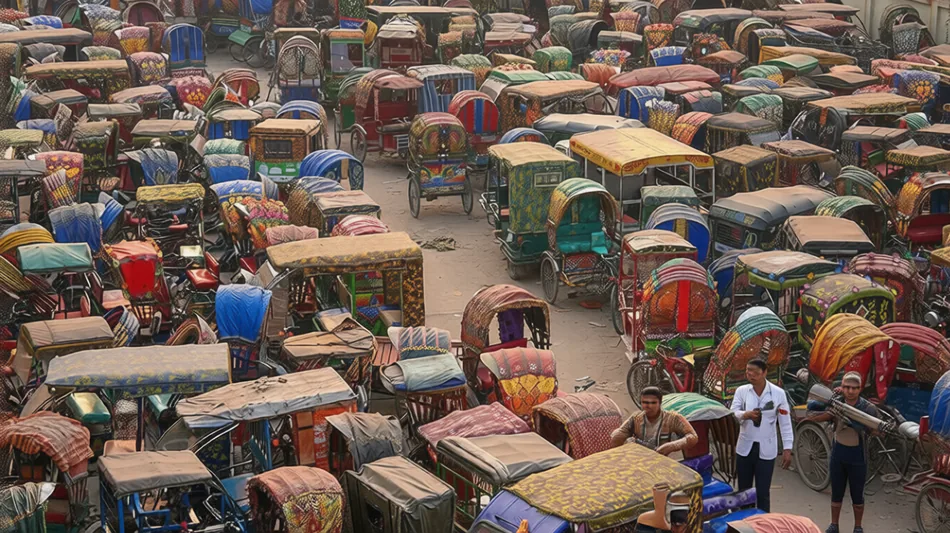
The proliferation of electric rickshaws in Bangladesh has precipitated a severe environmental and public health crisis, driven by the widespread use of cheap lead-acid batteries and their unsafe disposal. With between five and eight million such vehicles operating across the country, the demand for power sources has fueled an informal recycling industry that leaves behind significant toxic footprints in air, water, and soil.
The scale of the problem is evident in areas near Dhaka. Less than a kilometer from the protected Bhawal National Park in Gazipur district, remnants of a lead-smelting operation were found abandoned in a forest clearing during the summer. The site featured cement-covered ground with three furnace-like holes and tanks containing dark, pungent liquid consistent with spent battery acid. Melted plastic from cell frames, often encasing heavy-duty lead-acid batteries, was scattered nearby.
Local residents and workers at an adjacent fish hatchery reported that used batteries arrived by truck for dismantling. Workers typically operated overnight, arriving after 10 pm and leaving at dawn. Abul Kashem, a hatchery worker, noted that the smell of melting lead often spread through the area, disturbing sleep. Although the specific operation had ceased by the time of reporting, locals stated that such activities have occurred intermittently in the region for over a decade.
This pattern is replicated across Bangladesh, where used batteries are dismantled in workshops, homes, and backyards to extract lead for new cells. Battery-powered e-rickshaws, often dubbed "Bangla Teslas," began appearing nearly two decades ago. They have steadily replaced pedal-powered three-wheelers due to their affordability, low operating costs, and the minimal physical labor required to operate them. For many drivers, they provide a viable livelihood amid economic uncertainty.
The ubiquity of rechargeable lead-acid batteries, which dominate the market due to their lower cost compared to lithium-ion options, is central to the pollution issue. From manufacturing to recycling, these batteries leave a toxic trail. Recyclers break them open, discard acid, and smelt lead in crude pits or furnaces with few safety safeguards.
As regulatory scrutiny increases, some recyclers have become mobile, establishing temporary operations in secluded areas before packing up if they detect government attention. Dealers in Dhaka noted that cheaper batteries, which typically last eight months to a year, are popular among drivers who trade them in upon failure.
Erica Plambeck, a professor at the Stanford Graduate School of Business who has studied lead supply chains in South Asia, highlighted the inefficiency of this process. Recyclers recover lead and sell it back to manufacturers but lose up to 20% of the material during smelting, which ends up in the environment.
Industry estimates place Bangladesh’s lead-acid battery market at USD 870 million, projected to reach USD 1.1 billion by 2031. According to Pure Earth, a global public health non-profit, nearly 80% of this sector operates outside the formal system. Even within the formal sector, proper environmental clearance and recycling practices are uncommon.
Pure Earth reports that Bangladesh generates approximately 167,000 metric tonnes of lead waste annually from used batteries and has identified 290 contaminated sites. Local residents told Dialogue Earth that several examined sites had been shut down repeatedly only to reopen.
Accusations of corruption have emerged regarding enforcement. Multiple residents and NGOs accused government inspectors of favoring factory owners and, in some cases, accepting bribes. Fahmida Khanom, acting secretary at the environment and climate change ministry, stated that the authority has no formal corruption complaints on file but attributed enforcement difficulties to a shortage of inspectors.
"Our inspectors are not being able to keep up with this epidemic of lead pollution," Khanom said. "We admit that this crisis has become very massive."
While laws governing lead-acid battery recycling exist, they primarily apply to formal operators. Informal recycling has been illegal since the country’s main environmental law was passed in 1995. However, it has been tolerated as e-rickshaws operated in a legal grey area with little oversight.
Regulations are tightening. New rules introduced in October mandate the registration of e-rickshaws in major metropolitan areas and require compliance with environmental laws regarding the making, importing, using, recycling, and managing of vehicles and batteries. Dumping old batteries or parts in open spaces, soil, water bodies, or ordinary waste is now prohibited.
Officials are also developing extended producer responsibility rules to hold battery manufacturers and importers accountable for pollution associated with their products.
The formal sector contributes to the problem, as many registered battery companies source lead through informal channels. Bangladesh, which has no natural lead deposits, imports raw material from countries like India, China, and Singapore, or recovers it from used batteries.
In 2015, Bangladesh tightened battery import rules and closed loopholes to avoid high tariffs. Plambeck noted that because these duties are "extremely high," the country has shifted to importing raw lead and lead plates. Rising demand, fragmented policies, weak enforcement, and China’s shift toward exporting production have led to the establishment of Chinese-owned factories in Bangladesh.
One such facility, Xinyuan Storage Ltd in Narsingdi district, was shut down in April 2025 over environmental compliance concerns. Dialogue Earth visited the site in Fulbaria village and spoke with residents who claimed to have lost paddy fields to lead contamination. Some reported livestock deaths after drinking contaminated water.
Runa Begum, whose family owns farmland behind the factory, stated that her cows suffered from illnesses and one died after drinking contaminated water. She also claimed that eight to ten chickens and ducks died after consuming water or paddy from the fields during the factory’s operation. Begum could not provide veterinary records to support these claims.
The factory faced protests from approximately 4,000 residents in Fulbaria and nearby villages over more than a decade. A year before its closure, Xinyuan filed a criminal case against 19 villagers involved in protests regarding wastewater discharge.
Health impacts extend beyond agriculture. Moyna Begum, a former worker who separated acid powder from batteries, reported developing shortness of breath and gastrointestinal issues after six months at the facility. Sohel Rana, a welder who worked there for 18 months, stated that his wife, Asma, died in 2020 while eight months pregnant, resulting in a stillbirth. Two years later, his sister-in-law and her twins died during childbirth. Rana believed lead-contaminated water affected his wife’s health, noting ash buildup in stored water drums. Neither death was investigated for lead exposure.
A 2026 study co-authored by Plambeck followed 19,000 pregnant women in Bangladesh between 2009 and 2018. It found that after 2015 import barriers increased informal recycling, women living within five kilometers of such sites were 25-33% more likely to experience pregnancy loss compared to those living further away.
National data reflects the broader crisis. A 2025 survey by Unicef and the Bangladesh Bureau of Statistics found that over 38% of children aged 12 to 59 months and 7.5% of pregnant women had blood lead levels above safe thresholds. This was the first time blood lead was included as an indicator in the decades-long survey.
Mitali Das, Pure Earth’s Bangladesh country director, emphasized that shutting down polluting operations is insufficient due to decades of accumulated contamination. "The government also needs to invest in cleaning up abandoned and contaminated sites, because they continue to expose thousands of people to lead," she said.
Pure Earth has worked with the government on cleanup efforts, such as in Lobonchora, south-western Bangladesh. A lead-smelting factory near a residential madrasa operated for seven years before being shut down in 2017. In 2022, Pure Earth found soil lead concentrations as high as 43,000 parts per million, 215 times the US Environmental Protection Agency’s threshold for residential soil.
SK Shamim, a madrasa teacher who oversaw the cleanup, reported that students suffered watery eyes, asthma attacks, and behavioral changes. "I’m a math teacher, and I’ve seen firsthand how some of my students struggled to answer simple questions," Shamim said. "They became irritable and agitated and would fight over minor things. We didn’t know it was because of the contamination."
There is no safe level of lead in blood. Bangladesh has adopted a 10-year national strategy aiming to cut children’s blood lead levels by half by 2030 and by 95% by 2035.
However, challenges may intensify as the e-rickshaw industry expands. Research platform MarketsandMarkets projects the vehicle market will grow from USD 51.3 billion in 2025 to USD 94.8 billion by 2030, driven by demand for livelihoods.
Plambeck noted that Bangladesh stands apart in Asia due to its high volume of lead-acid batteries and strong government support for the domestic battery industry. "With such a huge amount of lead concentrated in such a small [country], Bangladesh is exposing a large number of people to risk in a way that is unique in the region," she said.
The full scale of lead exposure remains poorly understood due to limited testing, but the intersection of economic reliance on e-rickshaws and inadequate environmental controls continues to pose significant risks to public health.
H.Wenzel--BVZ