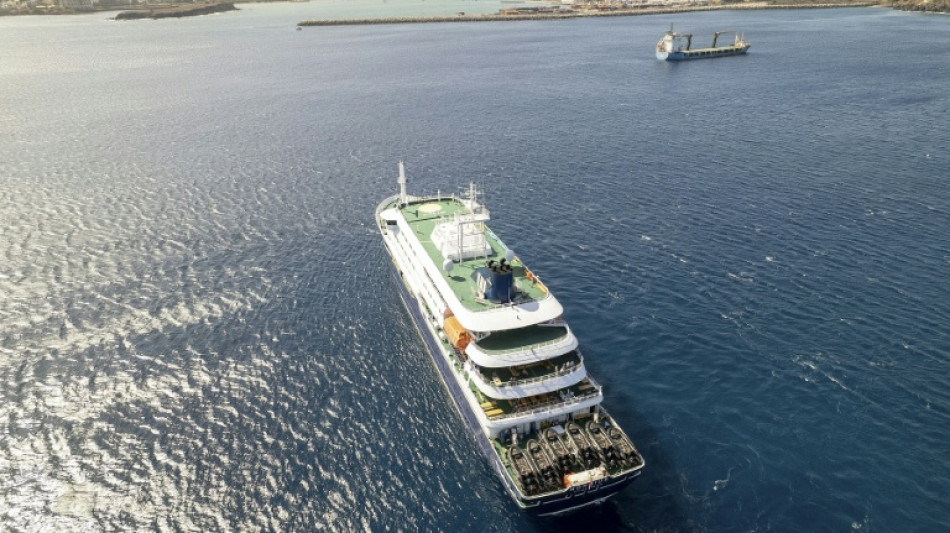
'Oh, gosh': Inside the race to test for cruise ship hantavirus / Photo: - - AFP/File

It was the start of a long weekend in South Africa on Friday when Lucille Blumberg received an email from a fellow infectious disease specialist about an unknown illness on a cruise ship.
She would go on to play an instrumental role in getting samples from people who had been on the ship tested for hantavirus, which revealed the rare illness was behind a deadly outbreak that has sparked an international health scare.
Blumberg, who works at South Africa's National Institute for Communicable Diseases in an honorary capacity, told AFP it was an email from a "personal contact that started it all off".
The contact, a disease consultant for Britain's overseas territories, told her a patient on a cruise ship with pneumonia-like symptoms had been evacuated to Johannesburg from Ascension Island in the South Atlantic.
She was also told that a Dutch man had died on the MV Hondius ship -- and his wife had collapsed at a Johannesburg airport while in transit to Europe.
The British passenger, who remains in intensive care in Johannesburg, initially tested negative for common illnesses on cruise ships such as influenza and Legionnaires' disease.
Blumberg said she requested a repeat of the test, with a sample "from low down in the lungs".
- 'Oh goodness' -
"I got the call" at 6 pm on Friday, the Workers' Day public holiday, confirming the patient was negative for the more common viruses.
By this time, Blumberg and a couple of others at the institute suspected it could be hantavirus because several of the ship's passengers had travelled to Argentina and Chile, where the virus is endemic.
So first thing Saturday morning, Blumberg requested a hantavirus test. The result came in that afternoon.
"The person doing it was like: oh goodness," Blumberg said. It was positive. They reran the test several times to be sure.
"Then we informed everybody, the hospitals, the WHO," she said. Contact tracing began soon after.
Early Sunday, Blumberg's attention turned to the Dutch woman, who was briefly admitted to a hospital in Johannesburg before she died from what had been thought to have been pneumonia.
"I suddenly thought, gosh, do we have any blood for that patient," she said.
The pathology lab normally only keeps such samples for a week, and it had been more than seven days.
"Please let it be there," Blumberg told herself as she called the lab at 7 am on Sunday morning.
"Fortunately, probably because Friday was a holiday, they did," she said.
The Dutch woman became the second confirmed hantavirus case in the outbreak.
"That was an important link," Blumberg said.
A third confirmed case, who departed the ship two weeks ago, is being treated in Zurich, Swiss authorities said on Wednesday.
According to the World Health Organization, there are five other suspected cases including two deaths, one of which was the Dutch woman's husband.
The WHO has emphasised that the risk to the public is low.
Humans normally catch hantavirus from infected rodents, typically through urine, droppings and saliva.
- First hantavirus on a ship -
The patients in Johannesburg and Zurich both have the Andes species of hantavirus, the South African and Swiss governments said on Wednesday.
This is the only kind of hantavirus known to be capable of spreading between humans.
However even this is "unusual," Blumberg said, with only two outbreaks reported in medical literature, and requires very close contact.
And there has never been a documented outbreak on a ship before, she added.
Manuel Schibler, the head of the virology lab at Geneva University Hospitals analysing the Swiss patient, told AFP that the "next step is to sequence the entire viral genome".
This could "establish a link with the geographic location of the first person infected by this virus," he said, adding this level of precision was "by no means certain".
Blumberg urged patience to allow experts to conduct the necessary tests and gather solid information.
While she has dealt with many outbreaks over her long career, Blumberg said she still had that initial feeling of: "oh, gosh, wow".
She emphasised that identifying hantavirus was a team effort, both inside the South African institutions and across the world.
"You cannot do this alone," she said, praising the WHO for being "instrumental" in bringing together different efforts to track down the virus.
A.Haas--BVZ