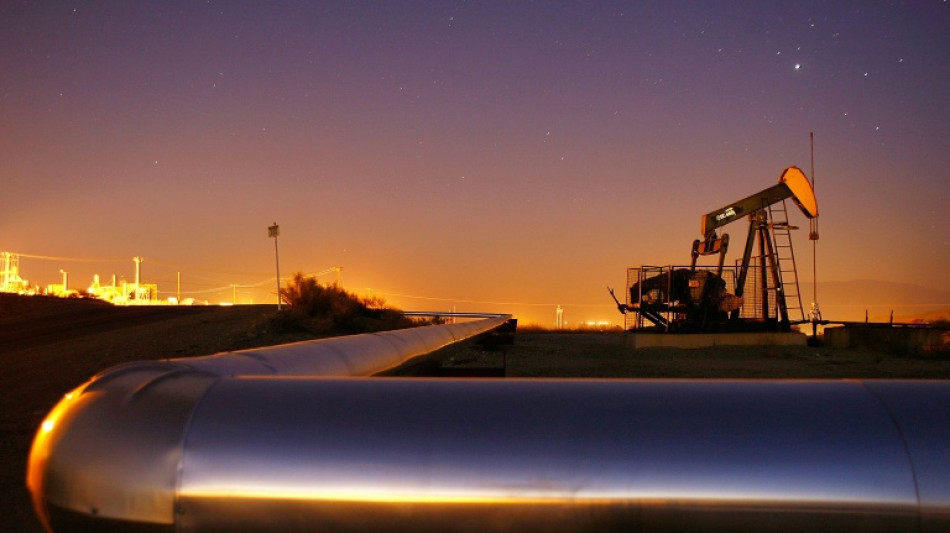
Stocks slide as oil climbs on Mideast flareup / Photo: DAVID MCNEW - Getty Images North America/AFP

Oil prices rose Wednesday on fresh concerns about Middle East supplies following a warning that Iran appeared to be stepping up attacks in the Strait of Hormuz, weighing on stock markets.
Crude futures had steadied Tuesday, helping Wall Street to fresh highs, with a large amount of the support coming from a rush back into the AI trade that saw chip titan Nvidia push towards a $6-trillion market value.
But Wall Street stocks pulled back at the opening bell, with a rise in bond yields on US government bonds to fresh 24-year highs as investors worried about inflation and interest rates.
"Rising Treasury yields and oil prices are creating renewed pressure after stocks received some relief from both fronts to start the week," said analysts at Briefing.com.
"In Europe, where there is a lower representation of AI-related names, investors are taking a more cautious stance," noted Russ Mould, investment director at AJ Bell.
"Oil prices remain above $100 a barrel and the inflation risks are clear to see," he added.
Figures have shown Tehran increasing strikes on tankers in the crucial Strait of Hormuz.
UK Maritime Trade Operations on Tuesday said there had been nine attacks this month, representing half of the September total in the waterway and the Gulf combined.
However US Secretary of State Marco Rubio said Wednesday that Iran has "lost complete control" of the Strait of Hormuz.
"There's almost as much oil flowing out now as there was before this conflict began," he told reporters during a visit to Athens.
Chris Weston, head of research at broker Pepperstone, said "reports of increased flows across the (Mideast) region have offered some downside pressure on crude, but this has been offset by varying reports around the scale of attacks on vessels moving through the Strait".
"For now, the market remains highly sensitive to headlines and geopolitical risk," he added.
Indian stocks slipped and the rupee steadied Wednesday as the Indian central bank hiked interest rates for the first time in more than three years.
The euro fell heavily versus the dollar for a second time this week as worries about France's high debt levels spook bond markets.
Marine Le Pen, frontrunner in the race to be France's next president, said Tuesday she would implement 140 billion euros ($157 billion) in cost savings by 2032 if elected next year, warning that without change France was "heading towards default" on its debt.
The pledge "has helped ease bond yields" in France even if "pushing through that level of cuts... would be a hugely difficult task", said Susannah Streeter, chief investment strategist at Wealth Club.
- Key figures at around 1330 GMT -
New York - Dow: DOWN 0.6 percent at 51,204.24 points
New York - S&P 500: DOWN 0.4 percent at 7,786.74
New York - Nasdaq Composite: DOWN 0.6 percent at 27,440.71
London - FTSE 100: DOWN 0.6 percent at 10,477.75
Paris - CAC 40: DOWN 1.1 percent at 7,776.26
Frankfurt - DAX: DOWN 1.3 percent at 25,107.37
Tokyo - Nikkei 225: DOWN 0.9 percent at 70,035.71 (close)
Hong Kong - Hang Seng Index: DOWN 0.6 percent at 24,130.50 (close)
Shanghai - Composite: Closed for a holiday
Brent North Sea Crude: UP 1.2 percent at $101.81 per barrel
West Texas Intermediate: UP 0.8 percent at $90.11 per barrel
Euro/dollar: DOWN at $1.1180 from $1.1257
Pound/dollar: DOWN at $1.3199 from $1.3275
Dollar/yen: UP at 158.37 yen from 158.17 yen on Tuesday
Euro/pound: DOWN at 84.72 pence from 84.81 pence
burs-bcp-rl/pdw
W.Hofmann--BVZ