China's economy likely picked up pace in first quarter: AFP survey / Photo: - - CN-STR/AFP

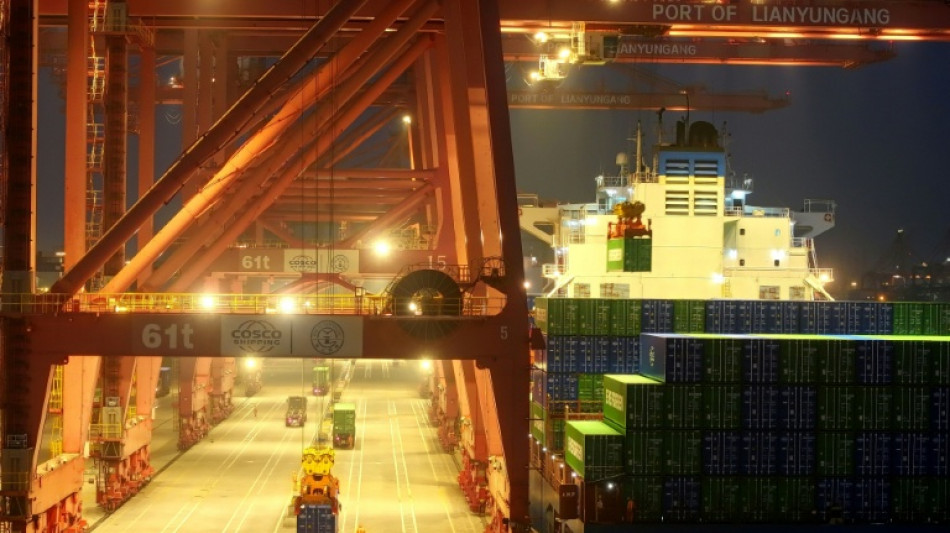
China's economic growth likely picked up in the first three months of the year, according to analysts surveyed by AFP, boosted by exports now impacted by the Middle East war, while domestic demand remains weak.
Leaders in the world's second-largest economy have struggled since the pandemic to rely on overseas shipments to support gross domestic product as a long-running property market crisis forces consumers to crimp on spending.
That has also come amid a trade standoff with the United States that played a role in last year's growth reading coming in at its lowest level in decades.
Still, analysts expected the economy to have expanded 4.8 percent in the first quarter of this year, up from 4.5 percent in the final three months of 2025, according to the median forecast of an AFP survey before official results are published Thursday.
That is at the top end of the 4.5-5.0 percent target set by officials last month, though that figure is the lowest since 1991, excepting 2020 during the pandemic.
Sarah Tan of Moody's Analytics told AFP the headline economic growth in the range targeted by Beijing "masks underlying imbalances, with external demand driving growth as domestic momentum remains weak".
China's trade surplus last year reached an eyewatering $1.2 trillion, the largest on record.
The boom in shipments offers a key lifeline for Beijing, while persistent woes in the vast domestic real estate market weigh on investment and consumer moods.
- Middle East warning -
Dan Wang, a director on the Eurasia Group's China team, told AFP that "global dependence on Chinese exports increased (since the war) as China's full supply chain and energy security are less affected than other industrial nations".
Skyrocketing oil prices have also boosted demand overseas for Chinese electric vehicles, with official data last week showing shipments of those and hybrids rose 140 percent year-on-year in March.
"China's exports of green technology and products got a lift" last quarter, Gene Ma, Head of China Research at the Institute of International Finance, told AFP.
While figures Tuesday pointed to a slowdown in shipments last month, the surge in exports held up in the first quarter -- despite the Iran war, which "seems to be doing little to dent exports", wrote Zichun Huang of Capital Economics in a report on Friday.
Critical to withstanding pressure from the Middle East war is a long-term push by Beijing to ensure energy security, which experts say is now bearing fruit.
"China is unlikely to face significant direct impacts from the Middle East conflict," Sarah Tan of Moody's Analytics told AFP.
While China relies on oil imports, "it mitigates this exposure through diversified suppliers, ties with Iran, substantial strategic reserves and continued reliance on coal", she said.
Still, analysts warn that prolonged disruption from the Middle East war could eventually present hurdles.
"If the war triggers a broad global slowdown... China's exports will suffer too," wrote Macquarie economists Larry Hu and Yuxiao Zhang in a recent report.
"In that case, Beijing will step up domestic stimulus to offset the external shock, so that they can still hit this year's growth target," they wrote.
- Debt crisis -
Chinese leaders have battled weak domestic consumption since the end of the Covid-19 pandemic.
The slump comes as economists argue that the country must shift towards a model powered more by household spending than construction and exports -- long the key growth drivers.
Soaring energy costs caused by the Middle East war ended a three-year deflationary streak for the country's factory gate prices, data showed last week.
But Sheana Yue, senior economist at Oxford Economics, told AFP that "this type of energy-driven cost-push inflation is unlikely to generate sustained reflationary pressures without meaningful demand recovery".
A top concern is the years-long debt crisis in China's massive property sector, which began in 2020 and has spooked consumers.
Once a key storage of wealth, home prices across the country have stagnated, dissuading would-be buyers from investing.
"Consumption can't recover until property does," Derek Scissors, a senior fellow at the American Enterprise Institute, told AFP.
Until then, any improvement in official retail sales data "will be minor", he said.
F.Ritter--BVZ