Small US farm copes with fuel hikes from Mideast war / Photo: kena betancur - AFP

An hour's drive north of New York City, the greenhouses at Cropsey Farm are seeing their first leaves of kale, spinach and arugula emerge. But the farmer who runs the outfit is obsessed with something else: the soaring price of fuel.
Every year, Sue Ferreri typically allows a 10 percent "buffer" for production budgeting, "but it's well above that now...We're looking at 20, 25 percent, and it's mainly due to the diesel cost," she told AFP.
Fuel prices have jumped after the US-Israeli attack on Iran on February 28, which led to a blockage of shipping in the Strait of Hormuz, a key conduit of oil and fertilizer.
Earlier this week, a gallon (3.8 liters) of diesel -- the fuel most used on the farm located in New City -- rose as high as $5.70 compared with $3.70 in February.
It's essential to the entire operation here: irrigating young plants, spraying fertilizers and plowing the soil.
Shipping costs are up, too, Ferreri said, describing "insane" prices for the delivery of essential farm equipment. Recently when she wanted to order a $60 piece of equipment, the shipping cost was $200, she said.
- 'Pricey' -
Eight people grow flowers, vegetables and fruit using sustainable farming practices on the ten-hectare (25-acre) farm. Customers include restaurant owners as well as local residents who buy produce in a restored 18th-century barn.
Cropsey Farm was already hit by fuel prices hikes following the war in Ukraine and had begun adapting its methods even before the Middle East conflict broke out.
Now, that shift is accelerating.
"We've been switching more to smaller equipment just because it's more efficient on fuel and it can still do what we need it to do," said head mechanic Jonah Monahan.
For example, an ATV and walk-behind tractor are now on the farm -- both far less energy-intensive than the typical tractor.
But, added Monahan, "for big jobs, we still need the main tractor, which gets pricey."
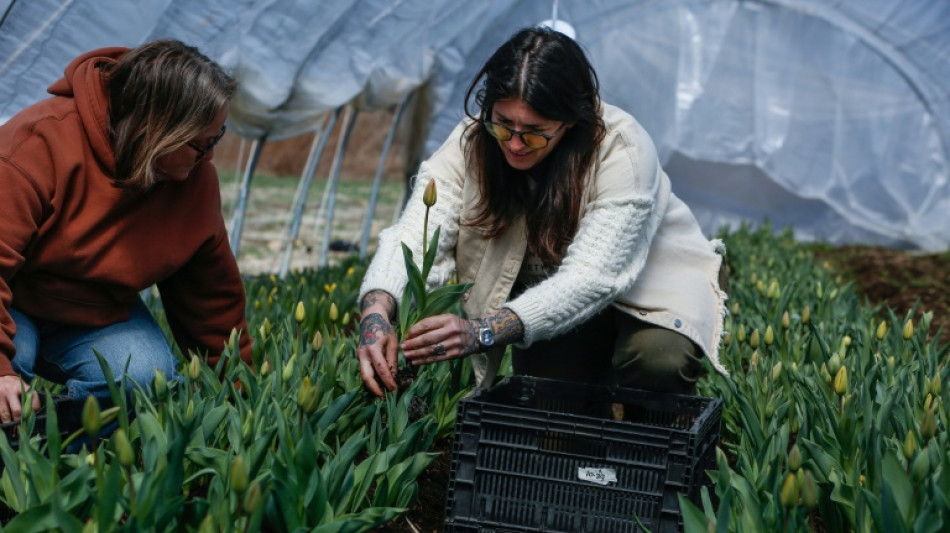
In one greenhouse, two women lifted tulip plants out of the ground and used a hand-drawn rolling cart to transport them to a refrigerated shed to await sale.
Everything is done to squeeze fuel costs.
- 'Relief' -
Beyond the tool adaptations, Ferreri said the farm is also shifting to "regenerative" practices, such as plowing the soil less deeply and maximizing space by rotating crops or pairing plants.
The rapid adjustments at Cropsey, typical of a small operation, have not yet reached larger farms, said Ben Brown, an agriculture researcher at the University of Missouri.
"At this point, most farms are left with taking the higher prices and figuring out how to make it work financially," Brown said.
"However, if elevated prices were to continue, we would expect to see producers shift some acreage to lower energy dependent crops," he said.
Ferreri said the fragile ceasefire agreed between Washington and Tehran gave her some "relief."
"But as a farmer, you can't trust the weather," she said. "We have to just anticipate the worst, hope for the best, and that's kind of where we're at."
A.Nagel--BVZ