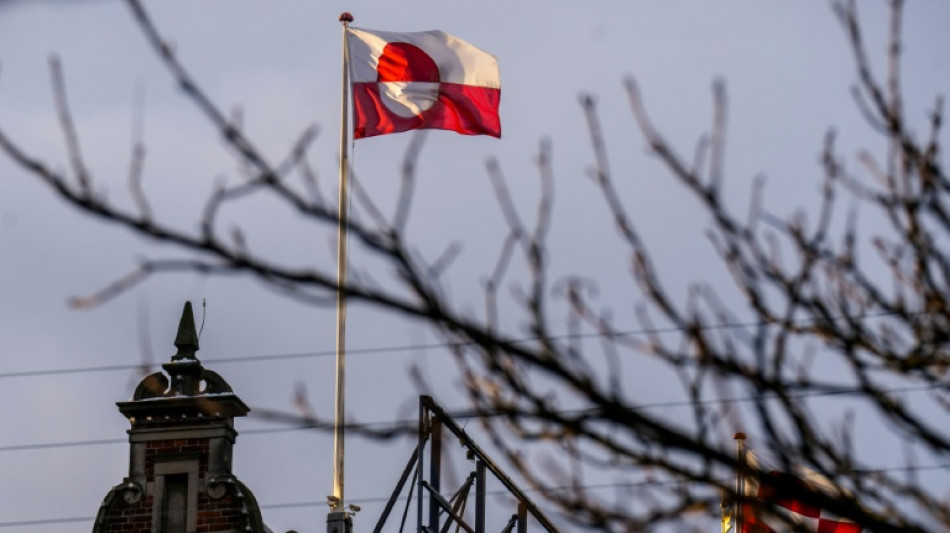
Nuuk, Copenhagen cautiously mull Greenland independence / Photo: Ida Marie Odgaard - Ritzau Scanpix/AFP
Denmark's self-governing territory Greenland hopes to cut all ties with Copenhagen but leaders are proceeding cautiously with independence plans despite US President Donald Trump's threats to take over the Arctic island.
Trump has repeatedly claimed the United States needs Greenland for its national security, while Denmark and Greenland have stressed the island is not for sale and that Greenlanders themselves must decide their own future.
"We have an agreement with our Greenland fellow citizens that they decide their future in freedom, based on their own assessments and their own will," Danish historian and former diplomat Bo Lidegaard told AFP.
"For us, it's a violation of everything we stand for, and everything we have agreed with the Greenlanders, if that decision is not taken in freedom and without coercion."
It is therefore out of the question to succumb to US pressure and "sell" a territory that has repeatedly said it does not want to be bought.
For Denmark, it is also out of the question to hold onto the vast Arctic island at any cost.
Greenland was a Danish colony until 1953, gaining home rule 26 years later.
Danish Prime Minister Mette Frederiksen has called Greenland's independence drive "both legitimate and understandable" but stressed that she herself wants to develop the Danish kingdom, which in addition to Greenland also includes the Faroe Islands.
"In modern times in the Nordic countries, if a territory wants to secede and become independent, it must be authorised to do so," Ole Waever, a political science professor at the University of Copenhagen, told AFP.
"Whether it was Norway in 1905 (which broke free of a union with Sweden) or Iceland in 1944 (which declared independence from Denmark), there has never been a civil war," he stressed.
- 'Very difficult' -
In the streets of Copenhagen, Danes are fine with the idea of Greenland separating from Denmark as soon as it feels ready.
"It's okay for them to be independent," said Charlotte Moltke, a 68-year-old pensioner.
"But I think it will be very difficult for such a small country for the time being ... on their own, when they know a big country like the US wants them," she added.
A roadmap for Greenland's independence was laid out in a 2009 Self-Government Act adopted by the Danish parliament.
"We are smarter than the Brits. We don't do a Brexit and then afterwards try to find out what it means. The arrangement is clear," smiled Waever.
Article 21 of the act stipulates that if the Greenlandic people decide to seek independence, negotiations must begin between the governments in Nuuk and Copenhagen.
At the heart of the thorny talks would be the question of the subsidies that Denmark gives Greenland each year -- currently some 4.5 billion kroner ($703 million), equivalent to around a fifth of Greenland's GDP.
Any independence agreement reached between Copenhagen and Nuuk has to be approved by both parliaments and endorsed by a referendum in Greenland, according to the act.
- Fragile economy -
A major question mark for a sovereign Greenland would be its economy.
The island is almost entirely dependent on fisheries and, like other European countries, will have to contend with the consequences of an ageing population, according to a recent report from Denmark's central bank.
"I don't think they're in a place where they can be economically independent. But if they want to try, sure, go for it. It's not up to us to decide," said Joachim Ziegler, a 24-year-old student.
While a large majority of Greenlanders are in favour of independence, most do not support the idea of a swift secession.
This is even though the sole opposition party, Naleraq, campaigned on such a platform in the 2025 legislative elections and won 24.5 percent of votes.
Naleraq has lunged at the opportunity to push for a speedy secession.
"I find it distasteful. What is happening is awful right now and they're using the situation to get independence," Inger Olsvig Brandt, an entrepreneur in Nuuk, told AFP.
"I know that of all of us Greenlanders wish to become independent but... they need to make a plan," she said.
At the political level, the current coalition government, backed by 75 percent of votes in the 2025 election, has been working on a more gradual plan for independence, basing itself on a draft constitution from 2024.
"No self-respecting Greenlandic politicians up until a year ago would state that he would rather stay within the Kingdom of Denmark and it's very difficult to go back," said Mikaela Engell, a Greenland specialist and former Danish representative on the island.
"But it's first an internal discussion in Greenland," she said.
J.Schwarz--BVZ