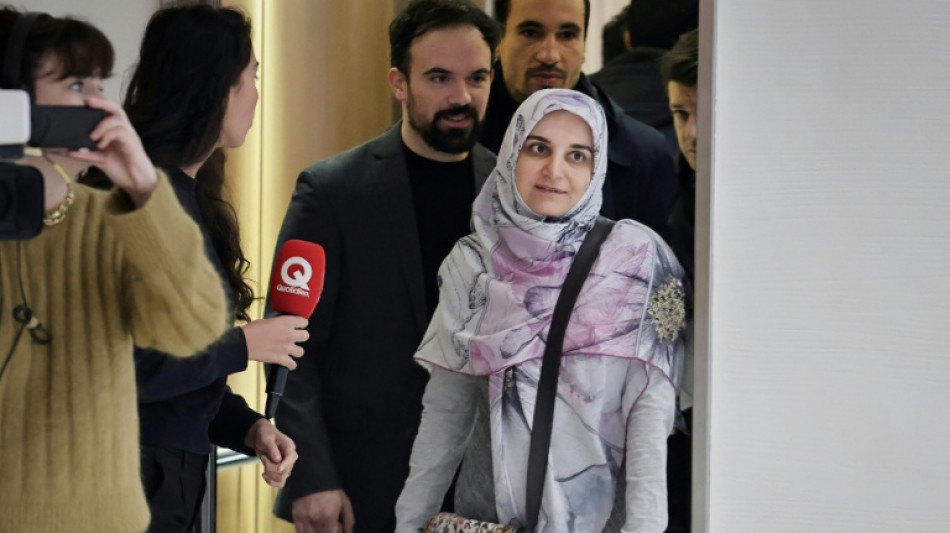
Iranian goes on trial in France ahead of possible prisoner swap / Photo: STEPHANE DE SAKUTIN - AFP

An Iranian went on trial in France Tuesday accused of promoting "terrorism" on social media in a case linked to a possible prisoner swap with two French citizens held by the Islamic republic for over three-and-a-half years.
Mahdieh Esfandiari, a 39-year-old Iranian, was arrested in France in February on charges of promoting and inciting "terrorism" on social media over comments she is said to have made, including on Palestinian militant group Hamas attacking Israel on October 7, 2023, according to French authorities.
Esfandiari was released in October pending her trial, whose date was scheduled long before the current protests erupted in Iran against the Iranian authorities.
"I'm here today to finally speak about the facts, as there have been a lot of wrong stories about me in the media, and a lot of lies," she said as she entered the courtroom for the four-day trial, in which several groups battling antisemitism are plaintiffs.
French citizens Cecile Kohler and Jacques Paris were arrested in Iran in May 2022, but they were freed in November after more than three years in prison on espionage charges their families vehemently denied.
They were immediately taken by French diplomats to France's mission in Tehran, but are still waiting to leave Iran.
Tehran's Foreign Minister Abbas Araghchi said in November that Iran would allow Kohler and Paris to return home in "exchange" for France freeing Esfandiari.
France has neither confirmed nor denied the existence of such an exchange deal.
But it has downsized its staff at its embassy in Tehran after mass protests erupted nationwide last week, in one of the biggest challenges to the clerical leadership since the 1979 Islamic revolution that ousted the shah.
Relatives of Paris and Kohler told AFP that they were in good health and being well looked after by the remaining embassy staff.
The demonstrations have triggered a crackdown that activists say has killed at least 648 people during an internet blackout.
France has described Kohler and Paris as "state hostages" taken by Tehran in a bid to extract concessions. They were convicted on espionage charges their families have always condemned as fabricated.
Dozens of Europeans, North Americans and other Western citizens have been arrested in the last few years in similar circumstances.
Iran has previously carried out exchanges of Westerners for Iranians held by the West, but insists foreigners are convicted fully in line with the law.
A.G.Meier--BVZ