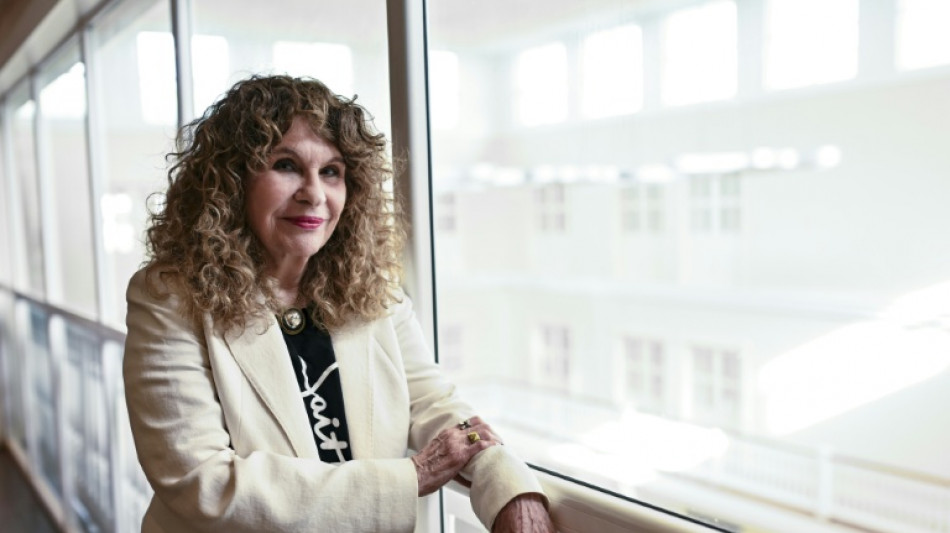
'They're afraid': Nicaraguan writer Gioconda Belli on fighting censorship / Photo: MARTIN BERNETTI - AFP
Exiled Nicaraguan writer Gioconda Belli said on Wednesday that the government censored the publication of her latest novel in her home country because it is "afraid" to hear the truth.
Belli, one of Latin America's most influential literary voices, said husband-and-wife co-presidents Daniel Ortega and Rosario Murillo fear voices that expose their betrayal of the leftist Sandinista revolution that toppled the US-backed right-wing regime of Anastasio Somoza in 1979.
Belli served in the early administrations of Ortega, then a Sandinista guerrilla icon, but the United States has since branded his government a dictatorship, accusing it of seizing total power with a constitutional rewrite and crushing dissent.
Belli, who lives in Spain after the government stripped her of her Nicaraguan nationality in 2023, explores the theme of betrayal in her novel "A Silence Full of Whispers."
The writer sat down with AFP in Panama, where she is attending the Centroamerica Cuenta literary festival.
Question: How do you view the evolution of Central American literature?
Answer: On one hand, it's still vibrant, but on the other, I feel it has suffered greatly due to the political context we're living through in Central America.
In a way, that suffering is the very thing that generates literature. It is truly a region that has endured great sacrifice. But at the same time, even under the cruelest dictatorships, it has still managed to produce fine literature.
Q: What role can literature play in this context?
A: Literature is a tremendous asset for Central America. It brings visibility to the region and it creates dreams, promises and possibilities. Literature cannot topple an authoritarian regime on its own, but it can encourage people to reflect on authoritarian tendencies and what that can mean for their own lives.
- 'Lost battle' -
Q: This is how censorship can occur.
A: Power has always feared the written word, and above all, the written word that speaks the truth. Dante was exiled, Victor Hugo was exiled. The written word compels you to think and a heightened conscience is one of the essential elements required to bring about change.
We're not going to end a dictatorship with poetry. However, if a poem leads you to a state of understanding, of awareness, and above all, aspiration, then you start to think about a different life, you want to live differently.
Q: Why do you think your novel was censored?
A: Because we hold a critical stance. Because we emerged from within Sandinismo, we know what Sandinismo originally set out to achieve, and we can't tolerate what they've done with it, how they have debased and manipulated it.
They know that we have the capacity, the moral authority and the background to expose and uncover exactly what they're doing. They're afraid of us.
Q: You've said that this book seeks to exorcize the power structure in Nicaragua.
A: It's a novel about the relationship between a mother and a daughter, but it's also a novel about disillusionment. The mother, having dedicated her entire life to the revolution, is left with the crushing sensation that her dream has been betrayed.
Q: In North Korea, films from South Korea still manage to find their way into the country despite censorship.
A: We have ways to communicate nowadays. I've sent a PDF of my book to my friends and asked them to distribute it. They can't control everything, no matter how much they want to. They've already lost that battle.
Q: Is there self-censorship in the region?
A: Being censored by others is one thing but I do not censor myself. I believe that one of my roles, as someone harmed by this regime and now living in exile, is to speak out on behalf of those who have no voice, to talk about what's happening.
There are so many people living in exile who fled with absolutely nothing left to their names. I have a name, a body of work, but there are people who are jobless, stripped of their pensions and left in a state of utter abandonment.
— 'Intoxicated with power' —
Q: Do you see any immediate possibility of being able to return home?
A: I don't see it as imminent, but I could be mistaken, and that's where my hopes lies. You never know what the future holds. I do see the end in sight. Both Ortega and Murillo are becoming intoxicated with power and doing reckless things. They're very afraid, more afraid than we are. I believe they're wearing themselves down considerably.
Q: What do you miss about Nicaragua?
A: It fills me with great sadness to think that I've lost my home, a place I loved deeply because I felt like a guardian of the landscape. Seeing the lake, the volcanoes, the vegetation, the flowers, I miss all of that.
Q: Did you ever imagine this would happen back when you were part of the Sandinista movement?
R: I never, ever imagined that this could happen. They have committed the most despicable and vindictive acts against the very people who risked everything for the revolution.
W.Arnold--BVZ