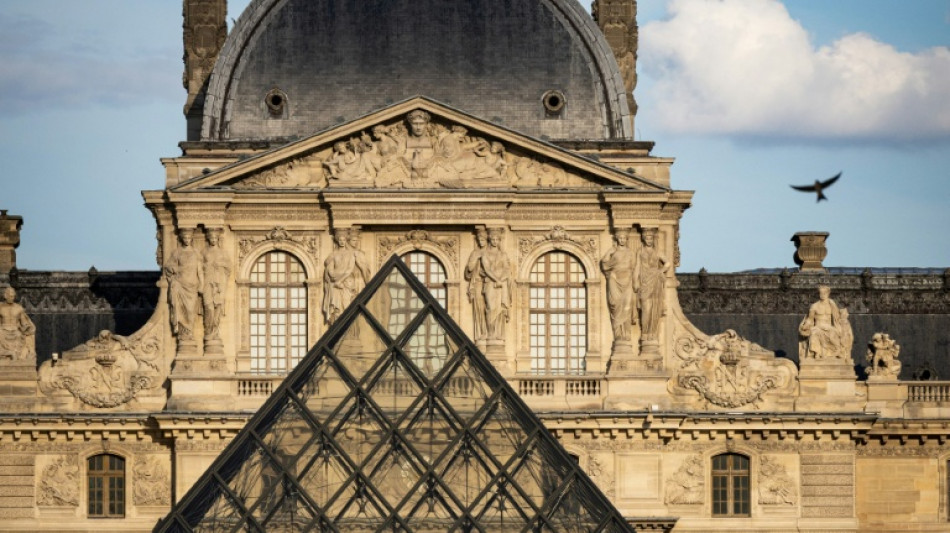
France unveils architects to transform Louvre / Photo: JOEL SAGET - AFP
France said Monday that it had selected an international team of architects to transform the Louvre, which has been hit by a litany of problems including a $100 million jewellery robbery.
The "Louvre-New Renaissance" overhaul, President Emmanuel Macron's signature project announced last year, will include a new space for the Mona Lisa and a new museum entrance.
The vast redevelopment project has been entrusted to STUDIOS Architecture Paris, the French branch of an international company, and Selldorf Architects, a firm founded by a German architect in New York.
A French landscape and urban planning agency is also part of the winning team, which was selected by a jury from among five shortlisted candidates.
The culture ministry said the winning proposal was selected for "the quality of its architectural approach and its integration in terms of heritage, urban, and landscape considerations", as well as security concerns.
The Louvre said "The proposal establishes an elegant link between the city, the palace, and the museum."
STUDIOS Architecture Paris contributed to the design of the Louis Vuitton Foundation in Paris and the LUMA Foundation in Arles.
Selldorf Architects is known for its work on the historic mansion that houses The Frick Collection in New York as well as the National Gallery in London.
Macron's aides have said the project is expected to cost 700 million to 800 million euros ($730 to 830 million). But the French Court of Auditors has put the price tag at 1.15 billion euros.
Under the plan, Leonardo da Vinci's masterpiece -- which attracts around 20,000 visitors a day -- will be independently accessible from the rest of the museum, with a separate ticket to see it.
The museum will also have a new entrance on its eastern facade to help ease congestion at its current glass-and-metal pyramid entry point.
That entrance was designed for just four million visitors a year when it was inaugurated in 1988.
The Louvre, the seat of French kings until Louis XIV abandoned it for Versailles in the late 1600s, now receives around nine million visitors a year.
The Paris landmark has become a subject of national concern following a months-long string of scandals.
Apart from the embarrassing theft of French crown jewels in October, the museum has struggled with strikes, a ticket fraud scheme that may have cost the museum 10 million euros ($11.7 million), a water leak and structural, maintenance and security issues.
M.Keller--BVZ