Calgary builder draws on decades of DIY work to increase Ford engine power

Calgary builder Gord McMillan has applied decades of self-taught engineering and fabrication work to extract far more power from vintage Ford engines.
It started with hot rodding a 1953 Victoria with a flathead V8, bumping the stock 100 horsepower to an impressive 350
When Gord McMillan wanted more power from his vintage Ford engines he started building his own speed components. Born in Vancouver but raised in Calgary, McMillan states his early interest in Fords started when he met Bob Harper in high school at Viscount Bennett. “There was an automotive shop at the school, but I never took that course,” McMillan, who will soon be turning 79, states. “Bob lived down the block from me, and he was a Ford genius. His dad was the head mechanic for Universal Ford Mercury. Bob was working on Ford motors when he was about eight or nine, and when I ran into him in our early teens, he started working with me and teaching me a bunch of stuff.”
McMillan’s first Ford was a 1953 Victoria with a flathead V8 engine. He started hot rodding the car and worked mostly with off-the-shelf pieces bought at the local speed shop. Eventually, he taught himself how to make his own parts and ultimately managed to obtain 350 horsepower from a supercharged flathead, an engine that would have originally produced some 100 horsepower. “My engines kept getting a little hotter,” McMillan explains. “Once I achieved that, there was nowhere else to go with the flathead. And getting into the early 1960s, 300 horsepower was nothing. It was out of a flathead, but everybody had a small block Chevy that would do that just from the factory. So that’s why I went over to the overhead-valve Ford Y-block.” Produced by Ford beginning in 1954 as a 239 cubic-inch V8, the Y-block was the automaker’s first production overhead valve engine. Described as a Y-block thanks to its uniquely shaped crankcase, Ford quit producing the engine for passenger cars in 1962, followed by heavy-duty trucks in 1964. Numerous displacement increases occurred, with the largest Y-block being a 312 c.i. example.
McMillan worked as an electrical engineer by trade but continued tinkering with Fords, and more specifically, the Y-block engines. “I found in quick order that a lot of the high-performance parts I would like to have on my Y-block weren’t made,” he explains. “And so, over a period of several years, I decided if I was ever going to continue with that motor, I had to get myself in a position where I could fabricate the kinds of engine parts that other people can get for more modern engines.”
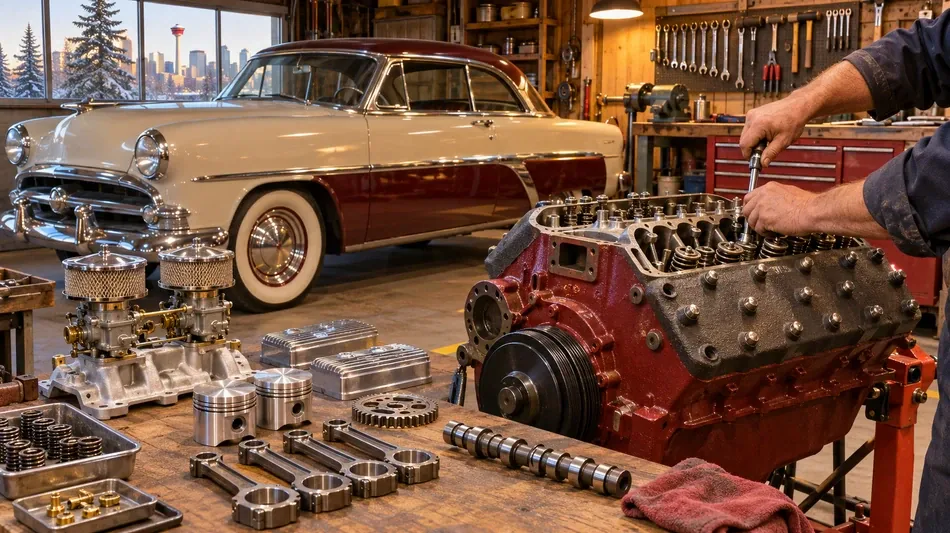
With skills he taught himself, one of the first components McMillan made for his Y-block was a set of four-tube headers. With them bolted to his engine, other Ford enthusiasts saw them and started asking McMillan if they could purchase a set. He established a small production facility in his Calgary garage, and then proceeded to build not only headers, but other pieces such as supercharger adaptor kits, finned valley covers, alternator brackets, thermostat housings and air filter assemblies. Many of these components are made from sandcast aluminum, and McMillan’s garage is well-equipped with a foundry and full machine and sheet metal equipment. From his RexHP.com website (for Rex High Performance), McMillan has sold Y-block Ford parts to customers around the world, including Australia, Europe, Brazil, New Zealand and the United States.
Many one-off custom parts have been fitted to McMillan’s personal 1956 Ford Victoria. The 312-c.i. Y-block casting is original to the car, but McMillan has completely updated the internals to handle the power made with the addition of a Weiand 177 supercharger. The exhaust headers are also one-of-a-kind. Power is sent to a Ford nine-inch rear end through a Tremec TKO five-speed overdrive transmission. McMillan has the Victoria on air-ride suspension, and the ride height has been lowered three inches. Wheels are more modern cast aluminum Ford rims, but the fronts have been narrowed by an inch and the rears widened by two inches. Originally featuring a four-bolt lug pattern, this set of rims has been modified to a five-bolt pattern, and they cover disc brakes all around the car. McMillan made his own molds to produce one-off glass fibre panels, including the hood, front fenders, trunk lid and bumpers. All of these can be opened and closed via electronic actuators McMillan controls from a key fob remote. All four windows are also power operated.
“I have spent 24 years on the construction of this project car,” McMillan states. “I wanted to make it look like a stock 1956 Ford with a few judicious body modifications. It’s painted flat black to make it look like it came out of a barn after fifty or more years. It’s quick, and a real sleeper.” It should be, as it bristles with McMillan’s lifetime of knowledge earned making Fords go fast.
A.G.Meier--BVZ