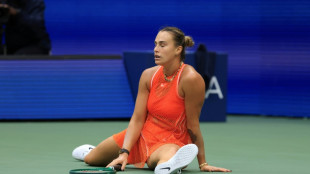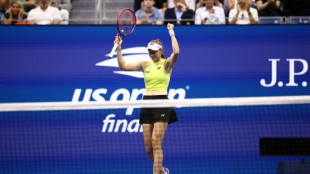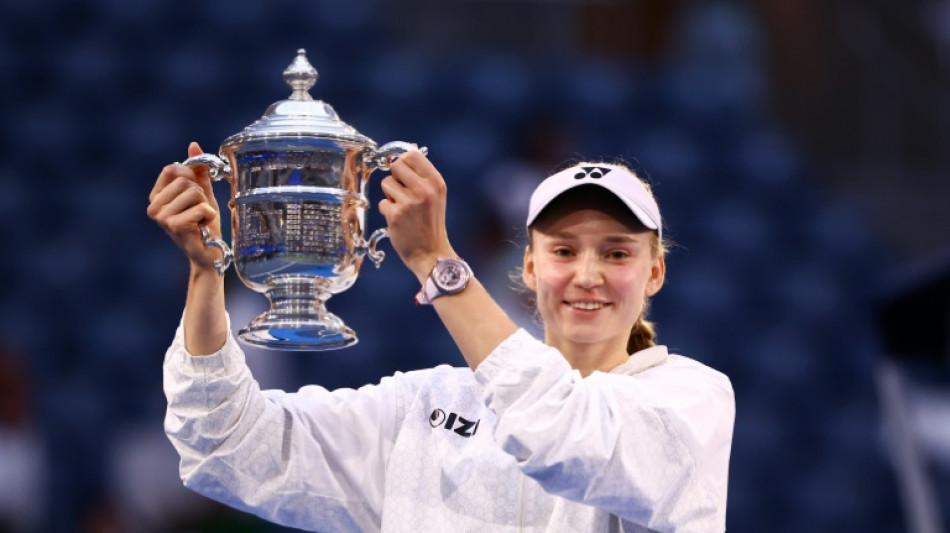
Rybakina reigns serene as new world number one / Photo: CHARLY TRIBALLEAU - AFP
Elena Rybakina punctuated her rise to world number one with a US Open title on Saturday, but the Kazakh star at the summit of the women's game remains an enigmatic figure.
The powerful game is there to see, but the thoughts and emotions driving it are largely shrouded -- and that's the way Rybakina prefers it to be.
"Elena is not nonchalant, I don't want to say that, but just no reaction ever," said American Coco Gauff, who fell to Rybakina in the semi-finals in New York.
"We're all feeling nerves and stuff. Now, how much of that she lets get to her, we don't know, and I think that's the strength of her. You can never see what she's feeling."
When Rybakina beat Ons Jabeur for her first Grand Slam title at Wimbledon in 2022, she didn't shout with joy or flop to the grass.
She raised one clenched fist before heading to her chair.
"I'm going to have to teach her how to celebrate properly," Jabeur quipped.
But Moscow-born Rybakina, who opted in 2018 to represent Kazakhstan, says it's a tactical choice to keep her feelings in check on court.
"Well, it's a lot of emotions," she said. "I'm trying to hide it, because you just don't want to let the opponent also see your frustration when something is going wrong.
"People who know me well, long enough, they read even little changes in my face."
Rybakina has found her famous composure challenged in the face of off-court controversy.
Russian players were banned the year she won Wimbledon, and she faced numerous questions about choosing to play under the Kazakh flag when she was a little-known 19-year-old ranked 175th in the world.
"They believed in me. There is no more question about how I feel," she snapped then, and when she cemented her rise to number one in the world by reaching the semi-finals in New York she spoke proudly of representing the country that backed her pro career.
"Every time I come back to Kazakhstan, no matter which city I go, it's always so many kids," she said. "Now they play tennis, and more and more are coming to the tennis facilities. It just proves that everything is possible if you believe, if you work hard."
But tennis stardom wasn't something she dreamed of as child, Rybakina said.
"I never thought that I'm going to be professional or I'm going to be even playing on these kind of tournaments on the biggest stages.
"I was just enjoying playing tennis after school, hanging out with the friends. It was just for fun."
Now she's a three-time Grand Slam champion. She bested Sabalenka in the Australian Open final in January to claim her second, four years after her Wimbledon triumph.
The intervening years had seen her on-off Croatian coach Stefano Vukov -- who guided her to Wimbledon success -- suspended over a potential breach of the WTA's code of conduct.
Vukov was reported to have used harsh and abusive behaviour towards players, claims he denied.
- Cool as a cucumber -
Rybakina was exasperated by the allegations and suspension, refusing to pose for a photo with WTA chief executive Portia Archer after Rybakina's victory at the Riyadh Masters in November 2025.
She's had Vukov back in her corner since the suspension was lifted.
Now the winner of 14 titles, Rybakina has twice led the WTA in aces in a season and has significantly improved her baseline game, according to American world number three Jessica Pegula.
But Pegula, like Gauff, thinks Rybakina's self-control remains her greatest strength.
"Cool as a cucumber," Pegula said after falling to Rybakina in the Australian Open semi-finals. "She's so chill. She doesn't really give you anything.
"You're not really sure if she's upset or if she's excited or what it is. I think in today's game that goes a long way."
H.Klein--BVZ