Frozen in time: Olympic legends on ice / Photo: DANIEL JANIN - AFP

With the Milan-Cortina Winter Olympic Games opening ceremony getting underway on February 6, AFP looks back at some of the golden stars of the ice rink.
Sonja Henie, ice queen to silver screen
After becoming the only woman to win three individual figure skating gold medals, Norwegian Henie went into movies and quickly became one of Hollywood's highest-paid stars.
Henie, the daughter of a track cycling world champion, made her Olympic debut aged 11 in Chamonix in 1924, finishing eighth out of eight.
At 15, she won the first of three straight golds, although her dinner with Adolf Hitler after taking the title in Garmisch in 1936 provoked harsh criticism at home.
She was the first woman skater to compete in white boots, although she switched to beige when her rivals copied her.
She was also the first to compete in a short skirt, saying: "I move less well with all that fabric."
Her Hollywood films, which invariably involved swirling routines, introduced movie audiences to skating.
Dick Button, the voice of skating
While Henie took skating to the movies, Dick Button became its voice when American television started broadcasting the sport.
The athletic Button became the first American skating gold medallist in 1948 in St Moritz, where he unveiled the double Axel jump.
He retained his title in 1952 in Oslo, where he achieved a perfect score after landing the first triple jump.
He studied law at Harvard but became a skating promoter and moved into television.
His "passionate and often tart commentary on figure skating competitions became a television staple over six decades," read his New York Times obituary in 2025.
Katarina Witt, dressed for success
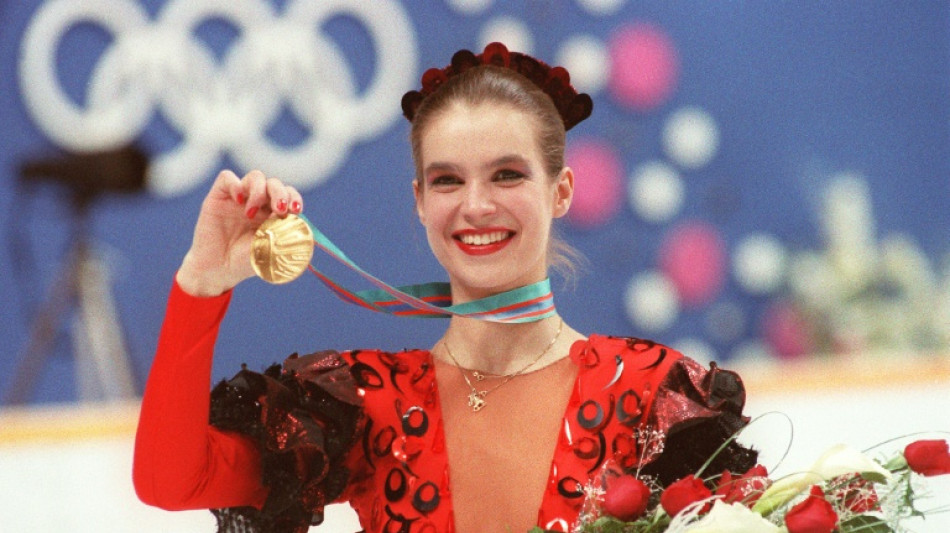
Witt dominated women's figure skating in the 1980s, winning four world titles and becoming the only woman since Henie to retain her Olympic gold medal.
Aged 18, the East German edged out American Rosalynn Summers in Sarajevo in 1984.
Four years later in Calgary, she faced a showdown with another American, Debi Thomas, who had briefly interrupted Witt's run of world titles.
Both skated to the same music by Bizet. Witt won the 'Battle of the Carmens' while Canadian Elizabeth Manley grabbed second place in a tight competition.
After the victory, American magazine Time called Witt "the most beautiful face of socialism".
But her gold was the last won at a Winter Olympics by the German Democratic Republic.
She later told the New York Times that she "flirted my way through the programme".
Witt won the 1988 World championships in a 'showgirl' one-piece trimmed with feathers which provoked the International Skating Union to pass the 'Katarina rule', requiring women to wear a skirt.
At the 1994 European championship, she dressed as Robin Hood, "like a man's costume, because I didn't want to be accused of seducing the judges this time."
Witt -- whose Stasi files revealed that she had been given great leeway to stop her defecting -- embraced professionalism, skating in a commercially succesful show with American Brian Boitano and appearing on TV and in films, including a cameo in an ode to moneymaking sport 'Jerry Maguire'.
At 28, Witt made a comeback at Lillehammer in 1994, representing a united Germany.
She finished seventh after an emotional routine set to 'Where Have All the Flowers Gone' and dedicated to war-torn Sarajevo.
Torvill and Dean, the dramatic duo
Britons Jayne Torvill and Christopher Dean rewrote the conventions of ice dance as they swirled to gold in Sarajevo in 1984.
The pair abandoned the tradition of stringing together contrasting musical snippets to showcase technical range in the long routine.
Instead they would use one piece to tell a story or deliver a message.
They earned the first perfect score under the old marking system, for artistic presentation, with a jokey routine to excerpts from the musical Barnum at the World Championships in 1983.
The next year for the Olympics, they compressed Ravel's Bolero to a slow-building four minutes, 28 seconds.
Since that was still longer than the permitted maximum for a routine, they spent the first 18 seconds of music swaying, building anticipation, before starting to skate.
They were again rewarded by perfect sixes from all nine judges for artistry.
Torvill, an insurance clerk, and Dean, a policeman, turned professional. A change in eligibility rules meant they were able to return to the Olympics in 1994 where, both in their mid-30s, they collected bronze.
V.Simon--BVZ