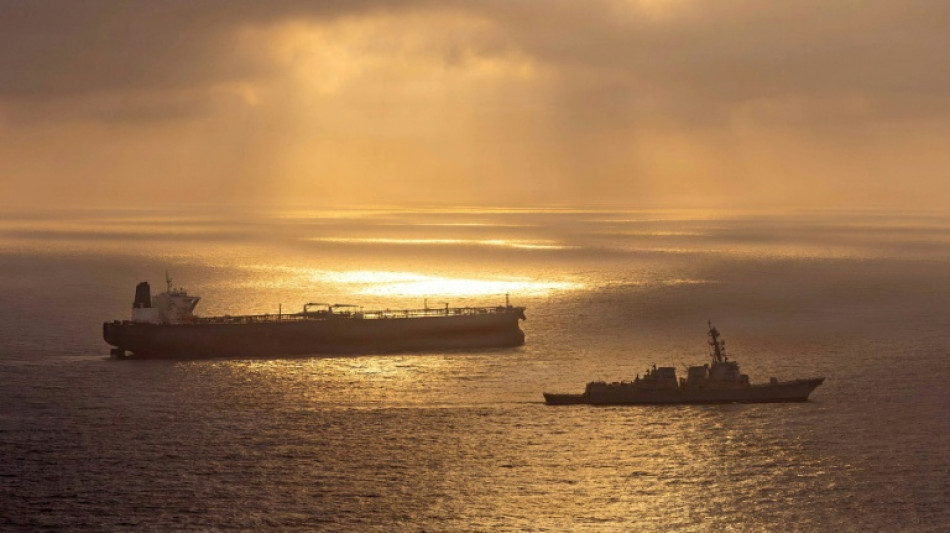
Iran, Qatar hold Hormuz talks as US blockade chokes Iran oil imports / Photo: - - US NAVY/AFP
Iran's top diplomat met his Qatari counterpart on Thursday in Tehran for talks on the strategic Strait of Hormuz, as a US naval blockade squeezes oil supplies to Iran amid a domestic shortfall.
The visit by Qatar's Foreign Minister Sheikh Mohammed bin Abdulrahman Al Thani follows a week of intense diplomacy in Iran involving separate meetings with Oman's top diplomat and senior Pakistani officials seeking ways to end the Middle East war and reopen Hormuz.
It also comes as Washington threatens wider secondary sanctions against countries, banks and companies that continue doing business with Iran, part of a broader campaign it has called "economic asphyxiation".
Iranian state television said Al Thani, who is also Qatar's prime minister, had met with Iranian Foreign Minister Abbas Araghchi, without providing details.
Qatar's foreign ministry said they discussed de-escalation efforts as well as the proposed framework for Hormuz between Iran and Oman.
Al Thani "emphasised the necessity of respecting the sovereignty of neighbouring states and freedom of navigation", and pursuing dialogue, the ministry said.
Alongside mediator Pakistan, Qatar had played a key role in securing an April ceasefire and June deal between Iran and the United States, but those deals have since collapsed.
- Fuel shortage -
Since war with the United States broke out on February 28, Iran has maintained tight control over Hormuz, a vital global energy conduit, with Washington imposing a naval counter-blockade on Iranian ports.
On Wednesday, Iran's Vice President Mohammad Jafar Ghaempanah said the blockade had prevented his country from importing enough petrol to cover a shortfall in domestic production.
"Petrol production is insufficient, and because of the US naval blockade, we cannot import it," he was quoted by the official IRNA news agency as saying.
In recent days, many Iranians have been seen queueing outside petrol stations. Presidential chief of staff Mohsen Haji-Mirzaei meanwhile said petrol quotas would be reviewed, without elaborating.
Iran, a major oil producer with some of the world's cheapest fuel, has for years heavily subsidised petrol, making changes to pricing politically sensitive.
As the United States seeks to strangle Iran's economy, Iranian officials have dismissed the measures as "failed policies" that will not force Tehran to change course.
"The country is in an all-out economic war," said Iran's top negotiator Mohammad Bagher Ghalibaf in a statement carried by local media.
"We will see that the government... will defeat the enemy on this ground as well," he added.
Even before the war, Iran's economy was battered by decades of international sanctions, and has long suffered from chronic inflation and a weakening currency.
- Talks on Hormuz -
Iran has for weeks been in talks with Oman, which also overlooks the Hormuz strait, over a framework agreement that would establish a "temporary corridor" for shipping and provide for clearing mines Tehran says were laid during the war.
Iran's Revolutionary Guards on Wednesday said the two countries had agreed on each country's share of the waters and any revenues collected from managing the waterway.
Tehran has nonetheless insisted that the strait will not be reopened unless Washington meets its demands, including lifting its naval blockade, unfreezing Iranian assets abroad and removing oil sanctions.
Since the war broke out, Iranian forces have required vessels to obtain permission to transit the waterway and struck ships that failed to comply.
Tehran has also sought to impose service fees on ships using the strait -- a move strongly opposed by Washington and regional countries.
On Thursday, the United Kingdom Maritime Trade Operations said an "unknown projectile" had struck a tanker in Hormuz this week, causing a fire that was later extinguished.
H.Lange--BVZ