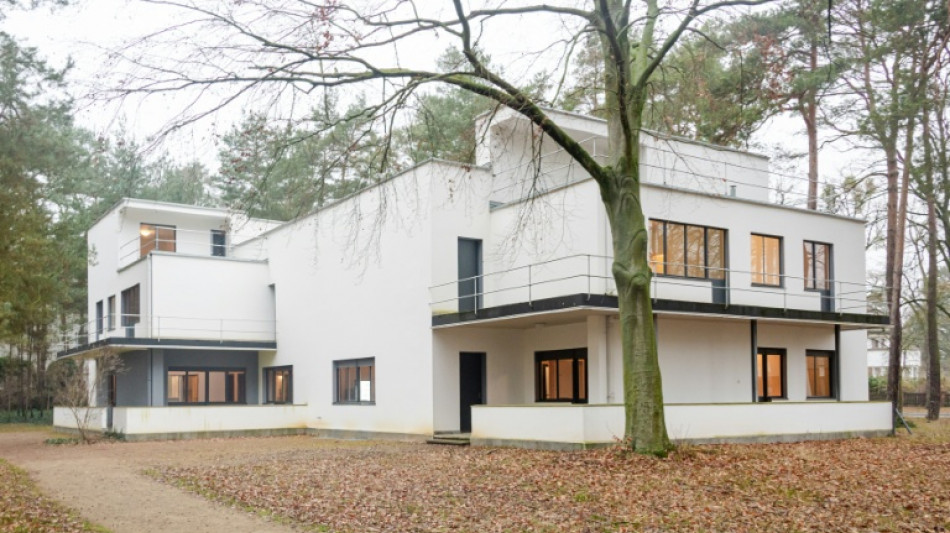
Manifesto defends Germany's iconic Bauhaus against 'populist attacks' / Photo: Anton Roland LAUB - AFP
Germany's culture minister and a group of art and design institutions voiced support Thursday for the iconic Bauhaus art school, whose modernist legacy has come under attack from the far-right AfD.
Alternative for Germany (AfD) politicians have launched repeated attacks on the hugely influential school of art and design that was founded in 1919 but shut down a bit over a decade later by the Nazis.
Culture Minister Wolfram Weimar published a "Bauhaus Manifesto 2026" together with the leaders of artistic, religious, crafts and architectural institutions to defend the movement as well as the Bauhaus Foundation in Dessau.
The manifesto argues that recent attacks from the political fringes echo some of the criticism levelled by the Nazis, who branded much Bauhaus-affiliated work as "degenerate art".
"The Bauhaus and the hostility it faced from the Nazi regime reminds us that a culture of remembrance is not a nostalgic look at the past, but a prerequisite for understanding our history and our democracy," the manifesto argues.
The movement was founded in the central German city of Weimar but was forced to move to Dessau -- in the state of Saxony-Anhalt -- in 1925 because of right-wing political pressure, moving into its iconic Dessau building in 1926.
"Today, exactly 100 years later, we want to defend the Bauhaus against populist attacks," the manifesto states.
Regional elections for Saxony-Anhalt loom in September, with the AfD leading in the polls and looking to take an outright majority for the first time.
The AfD's election campaign decries the Bauhaus and its legacy, alleging that promoting the movement amounts to "denying German identity" and threatening to slash public funding for the Bauhaus Foundation.
The far-right party has instead advocated more "patriotic tourism" and education, sidelining the modernist Bauhaus in favour of figures like Martin Luther, Otto von Bismarck and Friedrich Nietzsche.
The manifesto champions Bauhaus and its UNESCO World Heritage listed sites for their "immense international influence" on modern design and architecture.
The Bauhaus, the manifesto contends, still serves as a model for "the courage to pursue bold visions, the belief in the freedom of artistic thought, and the conviction that only an open society possesses the strength for cultural renewal".
Luminaries involved in Bauhaus included architects Walter Gropius and Ludwig Mies van der Rohe as well as artists Wassily Kandinsky, Paul Klee and Laszlo Moholy-Nagy.
The school briefly relocated a third time to Berlin in 1932 before being shuttered by the Nazis shortly after Adolf Hitler took power the following year.
Gropius and Mies ended up in the United States where they became major architects. Klee died in 1940 in Switzerland.
D.Franke--BVZ