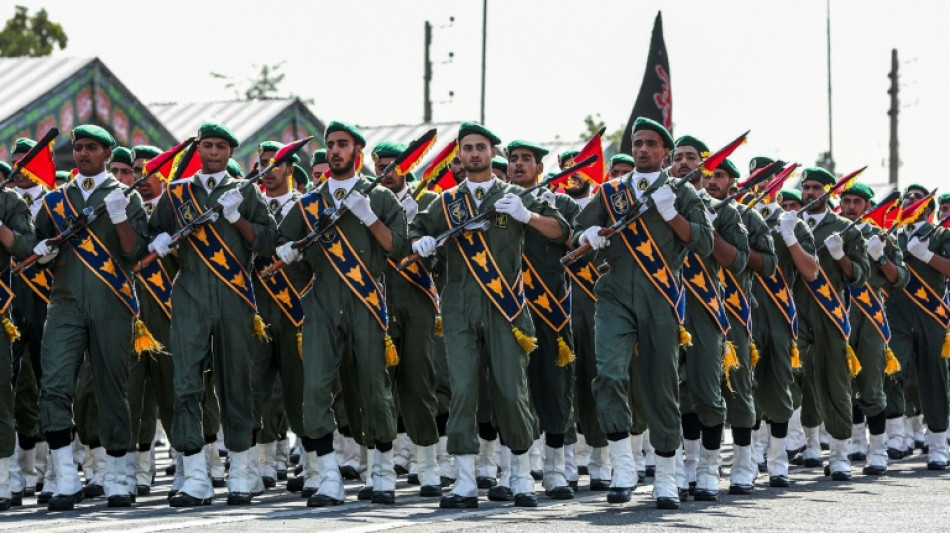
Iran's IRGC: the feared 'Pasdaran' behind deadly crackdown / Photo: - - Iranian Presidency/AFP
Iran's Islamic Revolutionary Guard Corps, which EU ministers agreed on Thursday to designate as a terrorist organisation, is the ideological army of the Islamic republic tasked with preserving the future of the revolution but which activists say played a frontline role in suppressing protests.
Celebrated as a pillar of the theocratic system by the Iranian authorities, it is accused by the West of militant activity abroad and serial rights violations at home.
Rights groups have accused the Guards of taking a lead role in the deadly crackdown on protests against Iran's clerical leadership under Ayatollah Ali Khamenei that has left thousands dead according to verified tolls.
Matching similar classifications enacted by the United States, Canada and Australia, the EU's move comes after years of pressure on the bloc by campaigners.
"The intolerable repression of the peaceful uprising of the Iranian people cannot go unanswered," said French Foreign Minister Jean-Noel Barrot as he announced late on Wednesday that Paris would back the terror designation, in a hardening of French policy.
Amnesty International said this week its evidence showed that, alongside regular police and plain clothes agents, the IRGC and its volunteer paramilitary force known as the Basij, were "involved in the deadly crackdown".
Known in Iran as the "Pasdaran" ("The Guards") or simply as "Sepah" ("The Corps"), the IRGC is a vast and complex organisation whose branches reach into many aspects of Iranian politics and society as well as the military.
Its international unit, the Quds Force, whose then-chief Qasem Soleimani was killed by the United States in 2020, has been accused by the West of carrying out attacks in the Middle East, while analysts say it is a key economic player, benefitting from illicit transactions that circumvent sanctions.
- 'Control the economy' -
The Guards' mission is "to propagate the ideas of the Islamic revolution", said Clement Therme, a researcher at the International Institute of Iranian Studies.
A Western diplomat, who requested anonymity to speak, said its membership was thought to be around 200,000.
"It's an armed force that functions like an elite military with terrestrial, maritime and aerospace capabilities, while it is better trained, better equipped and better paid than the regular military," the diplomat said.
The IRGC also serves as Tehran's link to its regional allies, such as Hezbollah in Lebanon and pro-Iran militias in Iraq.
"It's an empire within an empire," said David Khalfa, a researcher at the France-based Jean-Jaures Foundation.
The Guards control or own companies across the Iranian economy, including major strategic sectors.
Their annual military budget is estimated at around $6-9 billion, or 40 percent of Iran's official military budget, according to data collated by Khalfa.
"They effectively control the Iranian economy," he added.
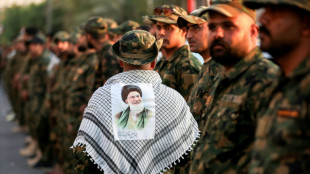
For enforcement on the ground, the Guards rely on the Basij, a force hundreds of thousands strong which is recruited mainly from young Iranians and acts as an ideological organisation embedded in all institutions and levels of society.
- Leader 'dearer than our lives' -
A research paper published this month by Saeid Golkar and Kasra Aarabi of the US-based think tank United Against Nuclear Iran (UANI) said a shadowy IRGC unit known as the Tharallah Headquarters, responsible for security in Tehran, was the "most critical cog in the IRGC's security and suppressive apparatus".
"It coordinates intelligence, policing, Basij militia, IRGC units and psychological operations, ensuring that repression is not improvised but calibrated," said Golkar and Aarabi, adding that it "functions as the regime's operational brain during moments of unrest".
The Guards are led by General Mohammad Pakpour, who was appointed by Khamenei after his predecessor Hossein Salami was one of several key military figures killed in an Israeli strike during the 12-day war in June 2025.
These losses revealed Israel's deep intelligence penetration of the Islamic republic, including within the IRGC.
On January 22, when the Islamic republic marks an annual day celebrating the Guards, Pakpour warned Israel and the United States "to avoid any miscalculations, by learning from historical experiences and what they learned in the 12-day imposed war, so that they do not face a more painful and regrettable fate".
In a show of bravado, given the fate of his predecessor, Pakpour that day also attended a public gathering with other generals from the IRGC and the regular army to show the unity within the Iranian armed forces.
"The Islamic Revolutionary Guard Corps and dear Iran have their finger on the trigger, more prepared than ever, ready to carry out the orders and measures of the supreme commander-in-chief -- a leader dearer than their own lives," he said, referring to Khamenei.
L.Becker--BVZ