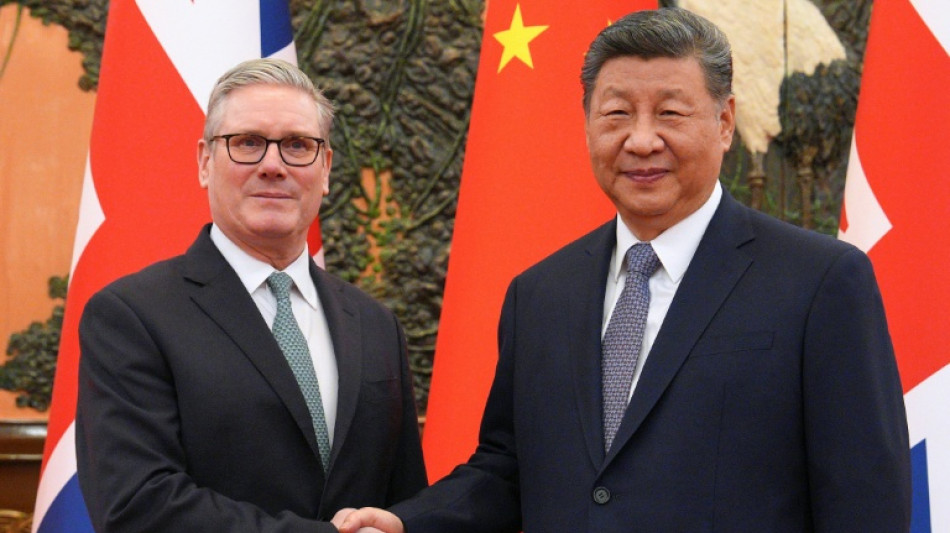
Britain's Starmer reports 'good progress' after meeting China's Xi / Photo: Carl Court - POOL/AFP
Britain's Prime Minister Keir Starmer said that "really good progress" had been made on issues such as visa-free travel and tariffs during talks with Chinese leader Xi Jinping in Beijing on Thursday.
Starmer's visit to China is the first by a British prime minister since 2018, and follows a slew of Western leaders seeking a rapprochement with Beijing recently, pivoting from an increasingly unpredictable United States.
The leaders met at the opulent Great Hall of the People, with both Xi and Starmer stressing the need for closer relations in order to face geopolitical headwinds.
Starmer told Xi that China is a "vital player on the global stage" and that they needed to "build a more sophisticated relationship where we identify opportunities to collaborate".
The Chinese leader stressed the need for stronger ties with a "long-term view" in the context of what he called a "complex" international situation.
"China and the UK need to strengthen dialogue and cooperation, whether it is to maintain world peace and stability or promote the economies and livelihoods of both countries," Xi told Starmer.
Cooperation, he said, would unlock a "new chapter" in their relations.
Starmer later told reporters that it was a "very good constructive meeting with real outcomes".
China is willing to "actively consider" implementing unilateral visa-free travel for British citizens, Chinese state news agency Xinhua quoted Xi as telling Starmer.
Starmer, who is in China until Saturday, also met the country's third highest-ranking official Zhao Leji and held talks with Premier Li Qiang.
The two countries are set to sign a cooperation agreement targeting supply chains used by migrant smugglers, according to Downing Street.
The issue of irregular migrants is highly sensitive for Starmer, who has promised to crack down on people smugglers and stem a wave of arrivals that has fuelled rising support for the far right.
Starmer will also travel to economic powerhouse Shanghai on Friday before making a brief stop in Japan to meet Prime Minister Sanae Takaichi.
- Economic cooperation -
Beijingers told AFP that Starmer's trip as well as recent visits by other Western leaders showed increased desire for economic cooperation with China.
Local Xie Yu, who lived in London as a graduate student, said that European economies have been hit hard by Trump's tariffs and were "struggling".
Xie said he hoped more Chinese would have the chance to study abroad as he did.
"Exchanges between young people can help be a foundation for overall ties between the two countries in the future."
London and Beijing enjoyed what they described as a "golden era" a decade ago but relations deteriorated from 2020 when Beijing imposed a national security law on Hong Kong and cracked down on pro-democracy activists in the former British colony.
Nevertheless, China -- the world's second-largest economy -- remains Britain's third-largest trading partner.
The prime minister is accompanied by around 60 business leaders as well as cultural representatives, as his centre-left Labour government looks to improve trade relations and fulfil its primary goal of boosting UK economic growth.
During the visit, British pharmaceutical giant AstraZeneca announced it would invest $15 billion in China through 2030.
"China... has become a critical contributor to scientific innovation, advanced manufacturing, and global public health," AstraZeneca chief executive Pascal Soriot said in a statement.
- Thorny issues -
Challenges to the bilateral relationship remain.
Starmer told reporters on Thursday that he had discussed with Xi the case of Hong Kong pro-democracy media mogul Jimmy Lai, 78, who is facing years in prison after being found guilty of collusion charges in December.
"We did have a respectful discussion about that," Starmer said, adding that he and Chinese leaders also talked about the treatment of Uyghurs.
Beijing has been accused of detaining more than a million Uyghurs and other Muslims since 2017.
Alleged spying and cyber attacks, and China's perceived support for Russia's war in Ukraine, have also strained ties.
The visit by Starmer, who took the helm in 2024, follows finance minister Rachel Reeves's trip to Beijing last year.
Starmer's trip comes as Britain faces a rift with its closest ally, the United States, following Trump's bid to seize Greenland and his brief threat of tariffs against Britain and other NATO allies.
I.Thomas--BVZ