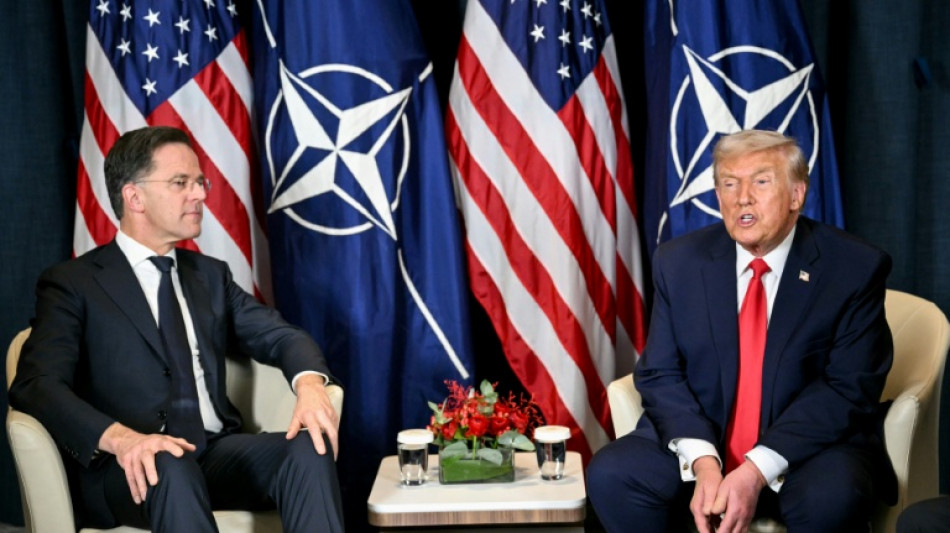
Wary Europeans huddle after Trump Greenland climbdown / Photo: Mandel NGAN - AFP
Shellshocked European leaders headed to Brussels summit talks Thursday breathing a collective sigh of relief after President Donald Trump's climbdown over Greenland -- but with few illusions about the perilous state of transatlantic ties.
NATO chief Mark Rutte appeared to have pulled off a diplomatic coup by talking Trump down from his Greenland demands -- but swirling questions over their purported deal, and what might follow, remained.
"Everyone agrees this charts a welcome path forward," a European diplomat said, summing up the mood among the bloc's 27 capitals, but he added: "We shouldn't be surprised if there are surprises."
Trump's threats over the vast Arctic territory -- an autonomous part of NATO member Denmark -- plunged relations between Europe and its key ally Washington to a historic low.
While the immediate danger to NATO seemed to have passed, the bloc maintained the emergency evening summit called to address the crisis -- its focus now on how to handle the unpredictable US leader going forward.
- 'Plan B' -
"Trump crossed the Rubicon. He might do it again. There is no coming back to what it was," said a second diplomat, warning leaders "need to understand we need a plan B".
The US president backed down Wednesday night both on threatening to seize Greenland by force and on imposing tariffs against European allies, saying he had reached a "framework" of a deal on the island that satisfied him.
The startling turnaround came after talks at the Davos forum with Rutte, who told AFP afterwards that there was "still a lot of work to be done".
Details remain scant on what was agreed, but a source familiar with the talks told AFP the United States and Denmark will renegotiate a 1951 defence pact on Greenland.
Trump said the accord would give Washington "everything we wanted" -- however, there was no sign he had succeeded in his repeated vow to make Greenland part of the United States.
Rutte said he did not discuss the issue of Danish sovereignty over Greenland with Trump, and that message was reinforced by Denmark's Prime Minister Mette Frederiksen -- who said she spoke with the NATO chief before and after his meeting.
- 'Way to go' -
It was still unclear what prompted Trump's U-turn -- and how far it was linked to the threat of retaliation from the EU, where calls were mounting to unleash the bloc's trade arsenal against the United States.
For a third senior European diplomat, "EU firmness and unity contributed to get him to change his position" but "internal political pressure in the US and market reaction" also came into play.
German Chancellor Friedrich Merz welcomed Trump's retreat over Greenland, calling it "the right way to go". But speaking in Davos he also warned of perilous times ahead.
"We have entered a time of great power politics. The international order of the past three decades anchored in international law has always been imperfect. Today, its very foundations have been shaken," Merz said.
Europe has struggled to set red lines as its once-close American ally has turned hostile under Trump -- to the point of threatening its sovereignty.
The continent is surging defence spending to break its security reliance on the United States -- but for now, it still needs US help to end the Ukraine war, and deter the looming Russian threat to its east.
Greenland is only part of the picture, as the United States wages a broader attack on the EU's laws, politics and values -- points pressed home by Trump on the stage in Davos.
Leaders are well aware any respite may be short-lived and indeed Trump was back with new threats as early as Thursday afternoon, vowing reprisals if European countries dumped US Treasury bonds to pressure Washington.
"We need to maintain our unity, solidarity, and vigilance," summed up the first diplomat.
L.Becker--BVZ