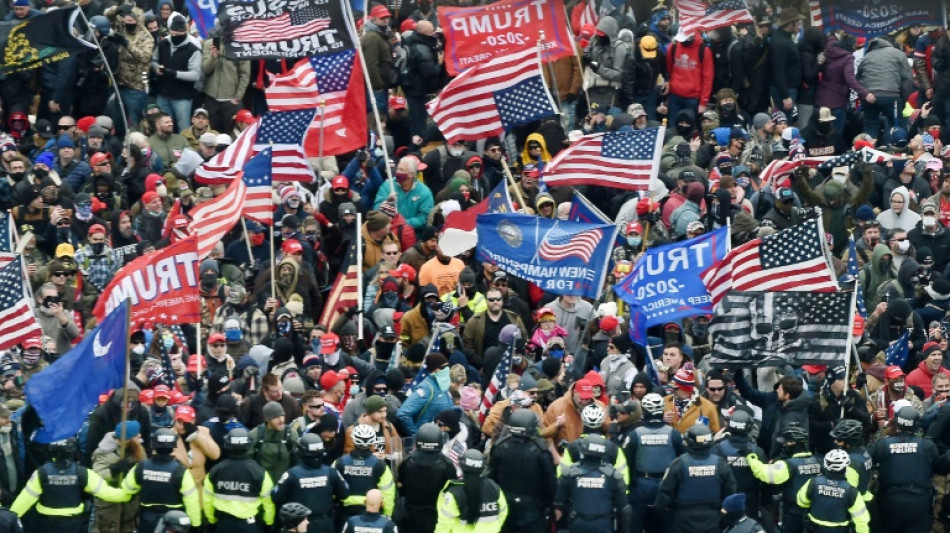
US Capitol riot anniversary exposes a country still divided / Photo: Olivier DOULIERY - AFP/File
Washington on Tuesday marks five years since a mob overran the US Capitol, with rioters pardoned by Donald Trump retracing their steps as Democrats revive hearings to hold the president accountable.
The anniversary of a day that reshaped American politics is expected to reflect a country still unable to agree on who was responsible, or what justice should look like.
"Five years ago today, a violent mob brutally attacked the US Capitol on January 6. Their mission was to overturn a free and fair election. We will never allow extremists to whitewash their treachery," top House Democrat Hakeem Jeffries posted on X.
On January 6 2001, thousands of Trump supporters gathered in Washington after the president urged them to protest Congress's certification of his election defeat to Joe Biden.
Several thousand breached the Capitol grounds, overwhelming police lines and wounding more than 140 officers, smashing windows and doors, ransacking offices and forcing lawmakers into hiding as the electoral count was halted for hours.
Inside the Capitol on Tuesday, House Democrats are convening an unofficial hearing featuring police, former lawmakers and civilians who experienced the violence firsthand.
Many involved in the original investigation say the aim is not to relitigate the past but to prevent it from being erased -- particularly after Trump returned to office and pardoned nearly all defendants charged in connection with the attack.
- Normalizing political violence -
A new Democratic report documents dozens of pardoned rioters later charged with new crimes, and they warn that the clemency risks normalizing political violence.
Outside the building Trump supporters, including figures linked to the far-right Proud Boys, are staging a midday march retracing the route taken by rioters in 2021.
The march is being promoted by the group's former leader Enrique Tarrio, who was serving a 22-year sentence for seditious conspiracy before Trump pardoned him.
Organizers say the march will honor those who died, including Trump rioter Ashli Babbitt, and protest what they describe as excessive force by police and politically motivated prosecutions, insisting the event will be peaceful.
The competing events mirror a broader political dispute, with Democrats saying Trump incited the attack to overturn the election. Republicans reject that view, instead citing security failures and criticizing the Justice Department.
Republican leaders have dismissed Tuesday's hearing as partisan and have shown little appetite for formal commemoration.
House Speaker Mike Johnson, an unswerving Trump ally, has yet to install a plaque honoring Capitol Police officers who defended the building that day, despite a federal law requiring it.
And Republican investigator Barry Loudermilk has argued that January 6 has been used to advance a political narrative against Trump and his allies.
The anniversary also arrives against the backdrop of unresolved legal and historical questions.
Former special counsel Jack Smith has said the attack would not have occurred without Trump, but abandoned the federal case after Trump's reelection, in line with Justice Department policy barring prosecution of a sitting president.
Trump was impeached by the House over the riot in 2021 and acquitted by the Senate.
A.Winkler--BVZ