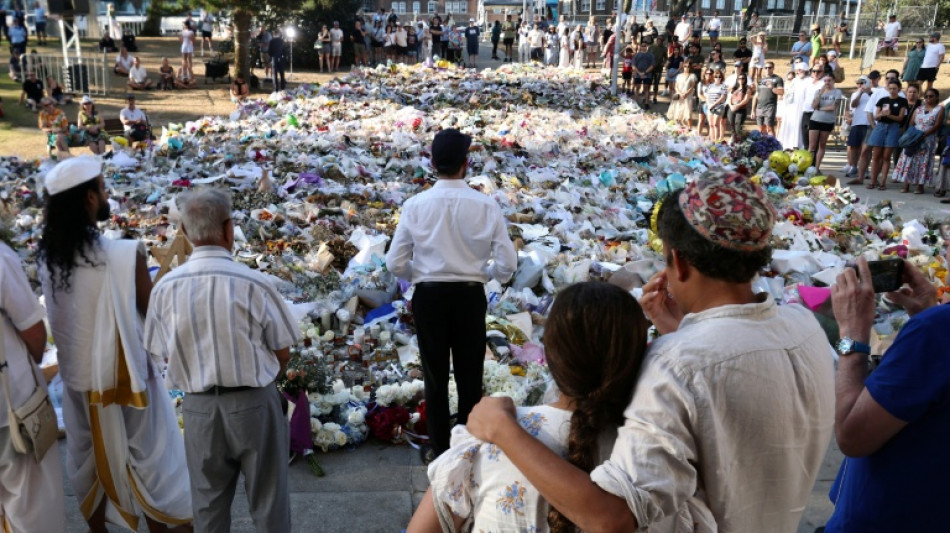
Australia falls silent, lights candles for Bondi Beach shooting victims / Photo: DAVID GRAY - AFP
Australians fell silent in flickering candlelight Sunday to honour the Bondi Beach shooting victims, marking one week since gunmen fired into crowds at a Jewish festival.
A father and son are accused of targeting the beachside Hanukkah celebration, killing 15 people including children and Holocaust survivors on one of the nation's darkest days.
From raucous city pubs to sleepy country towns, Australia observed a minute's silence at 6:47 pm (0747 GMT) -- exactly a week since the first reports of gunfire.
In a nationwide gesture of "light over darkness", countless homes lined their windowsills with candles.
"We're here together," said Roslyn Fishall, a member of Sydney's Jewish community.
"Turn to strangers and hug them. Let's make peace together," she told AFP from a makeshift memorial at Bondi Beach.
Summer winds buffeted flags dipped to half-mast across the country, including over the famed Sydney Harbour Bridge.
A seaplane buzzed above Bondi Beach trailing a message of love for "our Jewish community".
"It's still really difficult to understand what's been happening," said Leona Pemberton at the Bondi memorial.
"I guess the tears, they have to flow at some point."
A generation of Australians has grown up with the reassuring notion that mass shootings simply do not happen in the country.
That illusion was shattered when alleged gunmen Sajid Akram, 50, and his 24-year-old son Naveed trained their long-barrelled weapons on the nation's most famous beach.
The deadliest mass shooting in almost 30 years, the attack was so unthinkable that many shrugged off the first cracks of gunfire as harmless festive fireworks.
- Deep sorrow -
A deep sense of sorrow has settled over Australia in the past seven days.
Parents Michael and Valentyna trembled and wept as they buried their 10-year-old daughter Matilda, the youngest killed in the assault.
The Ukrainian migrants chose her name in homage to "Waltzing Matilda", Australia's beloved folk ballad.
Loved ones collapsed in grief as they travelled from one funeral to the next.
"The loss is unspeakable," said rabbi Levi Wolff.
The father and son drew inspiration from the jihadist Islamic State group, authorities said as they branded the shooting an antisemitic act of terrorism.
Already, it threatens to fray the bonds of social cohesion in a multicultural nation.
Pig heads have been dumped on Muslim graves.
Right-wing groups have organised a fresh wave of anti-immigration rallies.
Jewish community leaders have accused the government of ignoring a rising tide of antisemitism.
"Do we feel safe? You know, the answer is 'not really', to be honest," rabbi Yossi Friedman told AFP at a floral memorial for the victims.
- Immense bravery -
Grieving families are demanding to know how the gunmen slipped through the cracks.
Unemployed bricklayer Naveed was flagged by Australia's intelligence agency in 2019.
But he fell off the radar as authorities deemed he posed no imminent threat.
The government has announced a suite of national measures on gun ownership and hate speech, promising stricter laws and harsher penalties.
Prime Minister Anthony Albanese has announced a sweeping buyback scheme to "get guns off our streets".
It is the largest gun buyback since 1996, when Australia cracked down on firearms in the wake of a mass shooting that killed 35 people at Port Arthur.
A counter-terrorism task force is investigating why the duo travelled to the southern Philippines weeks before the attack.
Albanese has ordered a review of police and intelligence services.
Alongside the killings, stories of immense bravery have emerged.
Unarmed beachgoers grappled with the heavily-armed assailants, while others shielded total strangers or dashed through gunfire to treat the wounded.
Holocaust survivor Alex Kleytman, at 87 the oldest victim, was killed shielding his wife from bullets.
Shopkeeper Ahmed al Ahmed, a father of two who moved to Australia from Syria almost a decade ago, has been lauded after ducking between cars and then wresting a gun from one of the attackers.
Sajid Akram, an Indian national who entered Australia on a visa in 1998, was shot and killed by police.
Naveed, an Australian-born citizen, remains in hospital under police guard and faces multiple charges, including terrorism and 15 murders.
P.Baumann--BVZ