The round-the-clock monitors protecting Bhutan from glacier risk / Photo: Niharika KULKARNI - AFP

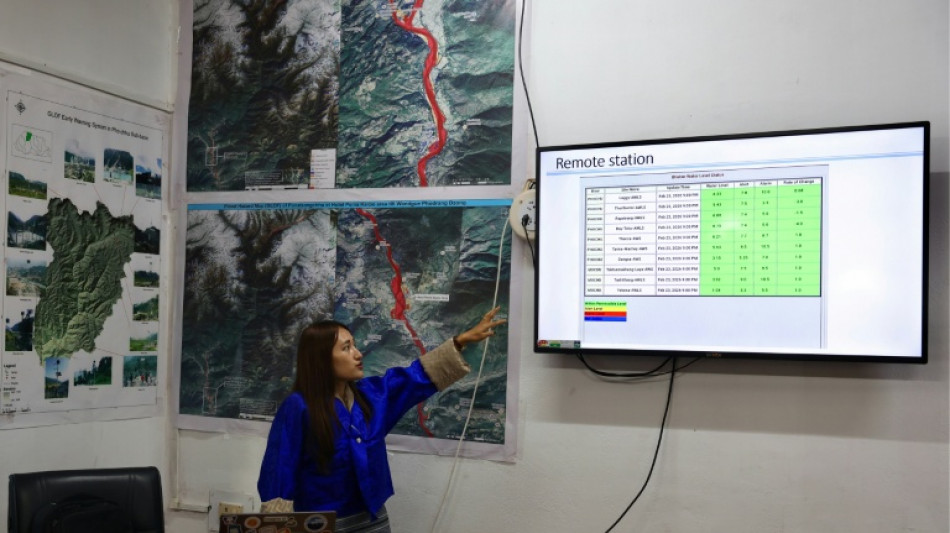
In a humble control room a few hours from Bhutan's capital, a team works around the clock to monitor the risks of the Himalayan country's rapidly melting glaciers.
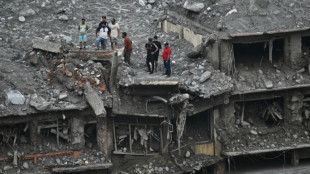
The glacial collapse that caused deadly floods on the Nepal-Tibet border late last month is a stark reminder of the dangers faced by Bhutan, which has over 600 glaciers nestled in the mountain ranges across its north.
As climate change melts these ancient ice rivers, they can form glacial lakes held back by fragile debris walls. When these collapse, the lakes burst and flood communities downstream.
The threat is not theoretical. In 1994, a so-called glacial lake outburst flood (GLOF) killed 21 people along Bhutan's Punatsangchhu river, also know as the Sankosh.
The risk has increased exponentially since then.
"The Thorthormi glacier, due to climate change, it has fully transformed into a glacial lake," said Dechen Peldon, junior engineer at the GLOF emergency warning facility in Wangdue Phodrang region.
"Now we have to be more vigilant and more concerned."
The warning centre began work in 2011, as part of a push for better monitoring after the 1994 GLOF.
It oversees a network of sensors that detect changes in water levels at glacial lakes and downstream rivers, and sirens that warn communities to evacuate.
There are over 600 glacial lakes in Bhutan, with 17 considered potentially dangerous.
Some of those considered most dangerous sit at the head of a river feeding into the Punatsangchhu.
Four glacial lakes have formed, with two only separated from each other by a fragile debris dam.
In a "worst-case scenario", the wall separating the lakes would collapse, unleashing an estimated 53 million cubic metres of water downstream.
- 'More vigilant' -
The nearest communities would have just minutes to evacuate, so sirens there are automatically triggered if water level changes suggest a potential GLOF.
Sirens further downstream are triggered manually by Dechen's team, which works 24 hours a day, if a dangerous change in water levels is detected.
Though the recent disaster in neighbouring Nepal involved a glacier collapse, rather than a GLOF, it has reinforced the urgency of the job, said Dechen.
"I'm more alarmed and taking this more seriously," she said.
"We, the control room operators, are more vigilant than we were before."
Working with the disaster agency, the facility organises mock drills and information sessions, but nearby cafe owner Pushpa Karki admitted she was not sure what the siren outside her business even sounds like.
"I've never have been part of any drill," the 30-year-old told AFP.
"They talk about mountain areas being prone to floods, so we are cautious. But I don't know about the glacier-related flood risk."
Around 70 percent of Bhutan's settlements are along rivers, and the government is trying to tackle the risk upstream.
In 2008, the country began a years-long project to dig out and widen a channel from the Thorthormi glacier lake. The gruelling, high-altitude work gradually lowered the level of the lake by five metres, reducing the pressure on the debris dam keeping it in place.
But continuous melt has filled the lake again, and now experts are trying to siphon water out, explained Bhutan's leading glaciologist, Karma, who uses a single name.
- 'So sad' -
"Our glaciers are melting at a very alarming rate," he told AFP at his office in the capital Thimphu, where he works as a specialist for the National Centre for Hydrology and Meteorology.
Bhutan's largest glaciers are retreating 30-35 metres (98-115 feet) a year, he said, while smaller glaciers are receding around 12-16 metres.
That is professionally concerning, but also personally painful for Karma, who decided to become the country's first glaciologist after accompanying Japanese experts surveying the region.
"I could literally climb on the glaciers," he said.
"But now you cannot do that... it's so sad actually."
Karma feels Bhutan's experience on the frontlines of climate change is especially unfair, given it absorbs more planet-warning carbon that it emits, partly because its laws require forest cover across 60 percent of its territory.
"The fear, the risk, which is being brought to the communities in Bhutan are not from our fault," he said.
"I would like to appeal to the rest of the world to take responsibility."
H.Meyer--BVZ