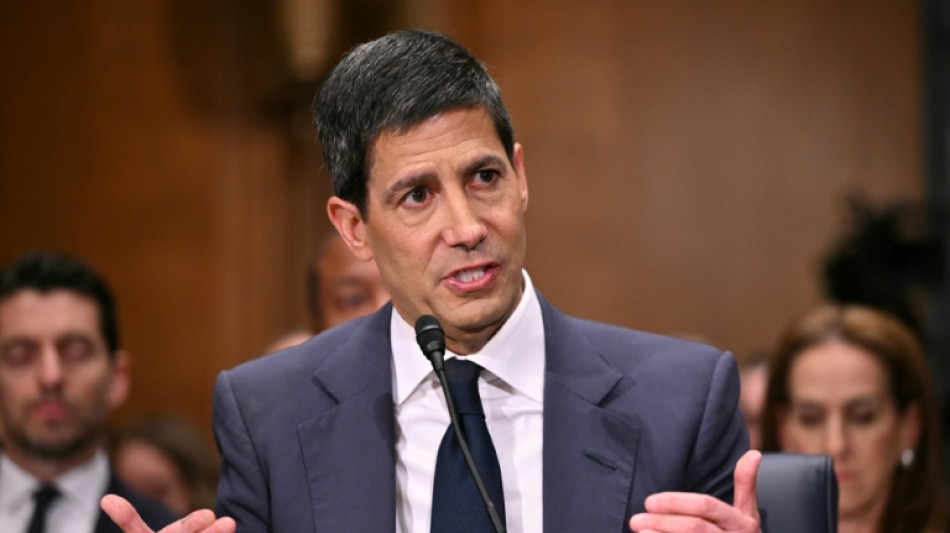
US Fed chair nominee says he will not be controlled by Trump / Photo: Mandel NGAN - AFP
Donald Trump's choice to lead the US Federal Reserve, Kevin Warsh, stressed Tuesday that he would not be controlled by the president as he fielded questions on his assets and central bank independence during his confirmation hearing.
Warsh, a former Fed governor, was quick to emphasize his commitment to "ensuring that the conduct of monetary policy remains strictly independent."
He added that he would "absolutely not" be Trump's puppet -- an accusation some critics have lobbed at him amid Trump's intense pressure on the Fed to cut interest rates.
"The president never asked me to predetermine, commit, fix, decide on any interest rate decision in any of our discussions, nor would I ever agree to do so," Warsh said.
Warsh also took aim at the Fed for missing its inflation target since the Covid-19 pandemic, warning that inflation becomes tougher to rein in once it takes hold.
The tense hearing before the Senate Banking Committee is closely watched as it marks a key hurdle that Warsh must overcome to succeed Fed Chair Jerome Powell when his term ends on May 15.
It comes as Trump has escalated criticism of the Fed for not cutting interest rates more aggressively.
Earlier Tuesday, Trump told CNBC he would be disappointed if the new Fed chair did not lower rates swiftly, and again slammed Powell for renovation costs at the bank's headquarters.
"We should have the lowest interest rate in the world," Trump said.
Warsh insisted that it is up to the Fed itself to stay free from political influence.
"I do not believe that independence of monetary policy is threatened when elected officials state their views on rates," he said in opening remarks.
- Proving himself -
All 11 Democrats on the Banking Committee last week urged for a delay in Warsh's nomination proceedings until separate investigations into Powell and Fed governor Lisa Cook are closed.
Republican Senator Thom Tillis, who sits on the panel led by his party, has also vowed to block all Fed nominees -- including Warsh -- until the Justice Department probe involving Powell is resolved.
Tillis urged Tuesday for the investigation on Powell to be dropped, saying that renovation cost overruns it looked into appeared legitimate.
With 13 Republicans on the 24-member committee, Tillis' vote against Warsh's confirmation could be enough to set up an impasse. Warsh needs to be confirmed by the panel to advance to a full Senate vote.
The hearing will be Warsh's "first chance since he was nominated by the president to demonstrate that he intends to be a credible, independent central banker," Brookings senior fellow David Wessel told AFP.
"He has to be really careful to not anger Trump," while avoiding the impression "that he's weak or subject to political pressure," Wessel said.
On Tuesday, Warsh added that the central bank must "stay in its lane" on policies.
Banking Committee Chairman Tim Scott called the hearing an "opportunity to refocus" the Fed on its dual mandate of price stability and low unemployment.
But Elizabeth Warren, the top Democrat on the panel, cautioned that probes on Powell and Cook were designed to pressure Fed policymakers into doing Trump's bidding, and warned against having "a sock puppet" of the president put in charge.
Warren pressed him for further details on some $100 million in assets that he agreed to divest if confirmed to the central bank.
- Inflation pressures -
ING economist James Knightley told AFP the focus will be on how closely Warsh is aligned with the president on rate cuts.
During Warsh's 2006-2011 Fed governor tenure, he was considered more "hawkish" -- a term for policymakers who favor controlling inflation by keeping interest rates higher.
But he appears to have shifted his stance, Knightley said.
Knightley pointed to indications that Warsh is an advocate for tech investments and AI, which some believe can change the US economy's ability to grow without generating the same degree of inflationary pressures.
Yet, higher gasoline prices due to war in the Middle East prove a more immediate challenge to rate cuts.
He will have to acknowledge near-term price shocks while explaining that these may not create a persistent inflationary threat, Knightley said.
V.Kern--BVZ