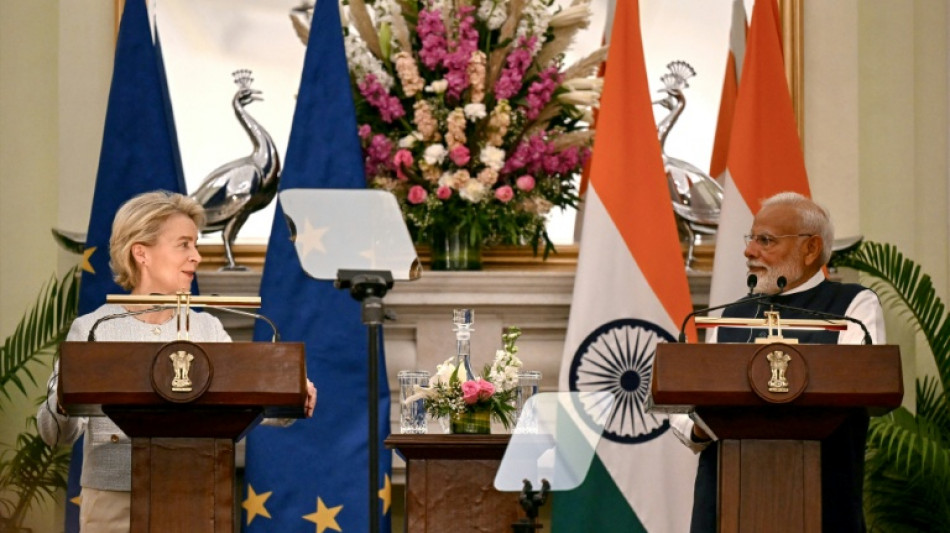
Europe and India seek closer ties with 'mother of all deals' / Photo: Money SHARMA - AFP
India and Europe hope to strike the "mother of all deals" when EU chiefs meet Prime Minister Narendra Modi in New Delhi next week, as the two economic behemoths seek to forge closer ties.
Facing challenges from China and the United States, India and the European Union have been negotiating a massive free trade pact -- and talks, first launched about two decades ago, are nearing the finishing line.
"We are on the cusp of a historic trade agreement," European Commission President Ursula von der Leyen said this week.
Von der Leyen and European Council president Antonio Costa will attend Republic Day celebrations Monday before an EU-India summit Tuesday, where they hope to shake hands on the accord.
Securing a pact described by India's Commerce Minister Piyush Goyal as "the mother of all deals", would be a major win for Brussels and New Delhi as both seek to open up new markets in the face of US tariffs and Chinese export controls.
But officials have been eager to stress there is more to it than commerce.
"The EU and India are moving closer together at the time when the rules-based international order is under unprecedented pressure through wars, coercion and economic fragmentation," the EU's top diplomat, Kaja Kallas said Wednesday.
- 'Untapped potential' -
Russia's invasion of Ukraine and US President Donald Trump's punitive tariffs have brought momentum to the relationship between India and the EU, said Praveen Donthi, of the International Crisis Group think tank.
"The EU eyes the Indian market and aims to steer a rising power like India away from Russia, while India seeks to diversify its partnerships, doubling down on its strategy of multi-alignment at a time when its relations with the US have taken a downward turn," he said.
The summit will offer Brussels the chance to turn the page after a bruising transatlantic crisis over Greenland -- now seemingly defused.
Together the EU and India account for about a quarter of the world's population and GDP.
Bilateral trade in goods reached 120 billion euros ($139 billion) in 2024, an increase of nearly 90 percent over the past decade, according to EU figures, with a further 60 billion euros ($69 billion) in trade in services.
But both parties are eager to do more.
"India still accounts for around only around 2.5 percent of total EU trade in goods, compared with close to 15 percent for China," an EU official said, adding the figure gave a sense of the "untapped potential" an agreement could unlock.
EU makers of cars, machinery and chemicals have much to gain from India lowering entry barriers, said Ignacio Garcia Bercero, an analyst at Brussels think tank Bruegel, who led EU trade talks with New Delhi over a decade ago.
"India is one of the most heavily protected economies in the world, with very, very high tariffs, including on many products where the European Union has a competitive advantage," he told AFP.
Its economy in the doldrums, the 27-member EU is also pushing to ease exports of spirits and wines and strengthen intellectual property rules.
India -- the fastest‑growing major economy in the world -- wants easier market access for products such as textiles and pharmaceuticals.
- Defence pact -
EU officials were tight-lipped about the deal's contents as negotiations are ongoing.
But agriculture, a sensitive topic in both India and Europe, is likely to play a limited role, with New Delhi eager to protect its dairy and grain sectors.
Talks are focusing on a few sticking points, including the impact of the EU's carbon border tax on steel exports and safety and quality standards in the pharmaceutical and automotive sectors, according to people familiar with the discussions.
Still EU officials said they were confident negotiations could be concluded in time for the summit.
An accord on mobility to facilitate movement for seasonal workers, students, researchers and highly skilled professionals, is also on the menu, alongside a security and defence pact.
The latter envisages closer cooperation in areas including maritime security, cybersecurity and counter-terrorism, an EU official said. It is also a "precondition" for the possible joint production of military equipment, said a second EU official.
New Delhi, which has relied on Moscow for decades for key military hardware, has tried to cut its dependence on Russia in recent years by diversifying imports and pushing its own domestic manufacturing base. Europe is doing the same vis-a-vis the US.
"We're ready to open a new chapter in EU-India relationships, and really to unlock what we think is the transformative potential of this partnership," said another EU official.
B.L.Walter--BVZ