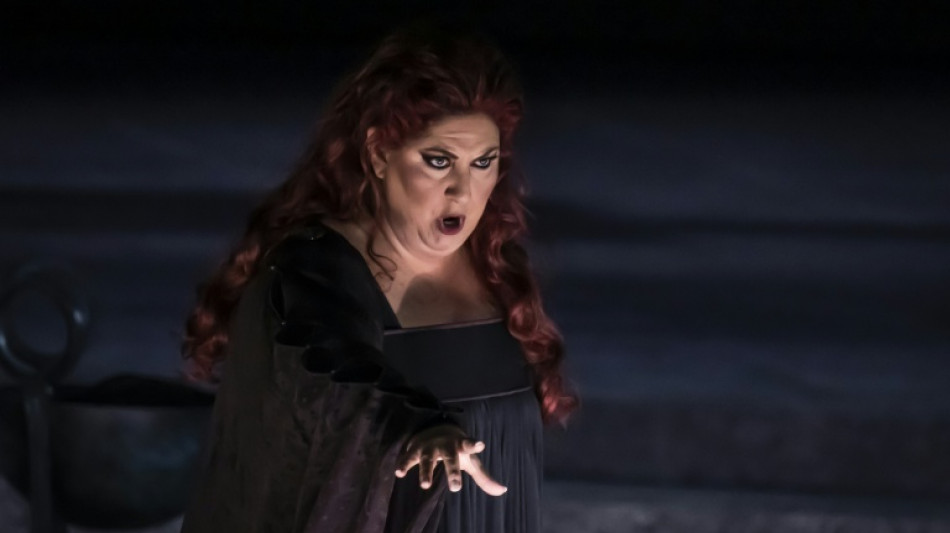
Ancient Greek theatre revives legendary Callas opera Medea / Photo: Aris MESSINIS - AFP

Sixty-five years after it last hosted an opera performance, Greece's renowned ancient theatre of Epidaurus is revisiting the seminal 1961 performance of Medea, headlined by Maria Callas in one of the legendary soprano's career highlights.
Saturday's one-night, sold-out performance stars Italian soprano Anna Pirozzi, who told AFP she intends to make the role her own in the 2,500-year-old amphitheatre renowned for its exceptional acoustics.
"I don't want to copy, I don't want to imitate" Maria Callas, Pirozzi said in her dressing room shortly before the dress rehearsal on Thursday.
"I love (...) how (Callas) interprets the role. I took a few gestures she used in 1961 because I think they're very dramatic," the 51-year-old added.
This lyric tragedy, in which Medea, a figure of Greek mythology consumed by fury and despair, kills her children, opens the 2026 edition of the Athens Epidaurus Festival.
The 1797 opera by Luigi Cherubini, inspired by Euripides's tragedy, was plucked out of oblivion by Callas's performance at the time.
Medea director Panaghis Pagoulatos said Callas and Pirozzi "share the same truth in their singing, in their acting."
"But they are not at all the same personality, not at all the same voice," he said.
- 'Legendary' performance -
Greek National Opera director Giorgos Koumendakis said the 1961 production was "legendary" and "sparked immense enthusiasm" far beyond Greece.
So for its revival, every detail underwent a colossal research effort -- from sets to costumes to lighting -- to reproduce the 1961 production as faithfully as possible.
"The main challenge was managing to grasp the aesthetic of the period and bring it into the present without it seeming (...) out of step," said Koumendakis.
The artistic teams, who worked for three years on this unique project, relied on the notebooks of the director at the time, Alexis Minotis, and on the drawings of Yannis Tsarouchis, one of Greece's greatest painters, who created the costumes and sets.
"We had notes on the choruses, on the choreography, on the extras, but not on the soloists," said Pagoulatos.
Another difficulty highlighted by Koumendakis is that "there is absolutely no" video recording from that time.
"We only have black-and-white photographs," he added, which were used to reconstruct the sets.
Every stone of this 4th century BC theatre, one of the best preserved in the ancient world, had to be covered with a wooden casing to protect it.
- Original costumes -
For the exceptionally beautiful costumes, the teams drew on some 150 outfits from the original performance that have been preserved.
Baritone Tassis Christoyannis, who plays Creon, king of Corinth, will be wearing the 1961 costume.
"The hardest part was the fabrics," because some are no longer produced today, such as silk jersey, explained costume supervisor Tota Pritsa.
Some fabrics had to be washed and rewashed multiple times to give them the patina of yesteryear.
"And if you look at the costumes (from the period) in sunlight, the colours are incredible!" Pritsa said.
On the balmy, starry evening of the dress rehearsal, even the director couldn't distinguish between the costumes.
"The old costumes and the new ones are mixed together (on stage), but even I can't tell them apart!" Pagoulatos said.
The archaeological site of Epidaurus, which includes the theatre, is currently hosting an exhibition devoted to the performances of August 1961.
One major difference on Saturday will be the number of extras on stage, which had to be reduced.
"At the time, they used young men doing their military service, so the stage was absolutely packed!" Pagoulatos said.
"But today we can't just walk into the barracks and say, 'All right, off we go, we're performing at the theatre tonight!'" he said.
Y.Zimmermann--BVZ