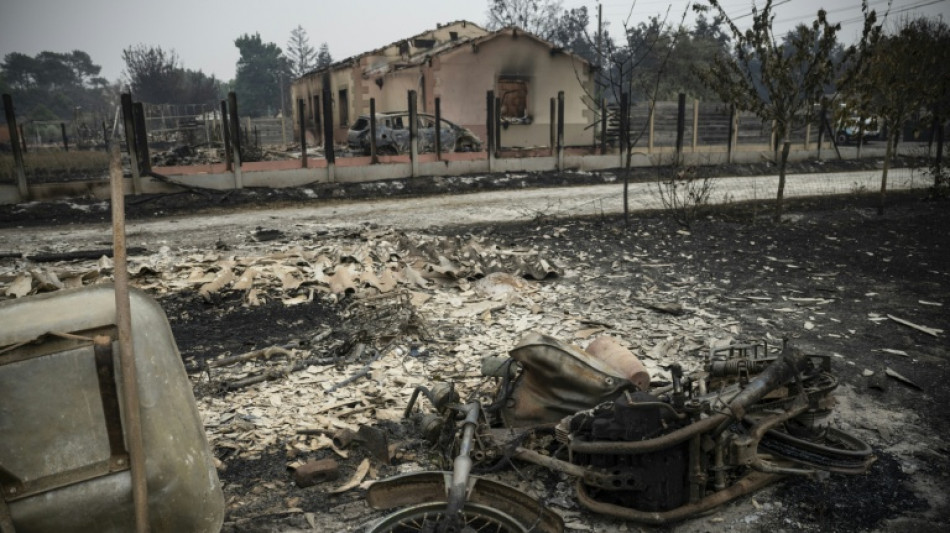
Fury of fire-ravaged French village at being 'sacrificed' for millionaires' peninsula / Photo: JULIEN DE ROSA - AFP/File

The blaze that has incinerated the French countryside west of Bordeaux is burning alongside the smouldering rage of residents who believe their homes were "sacrificed" to protect the swanky Cap Ferret peninsula nearby instead.
Tensions spilt over in the community hall on Monday when a man hurled abuse at the Gironde prefect as she came to meet the mayor of Le Porge, a village which saw 12 percent of its 1,500 buildings go up in smoke in France's worst wildfire since 1949.
"Now is not the time to play the blame game," Sophie Brocas told journalists after the confrontation, which saw police and security lead her away from the incandescent malcontent as a helicopter flew overhead, en route to the next blaze.
But for many locals, the difference between the support sent to their area and to Cap Ferret, a peninsula known for its millionaires' homes which was the focus of France's early firefighting efforts, tells its own story.
Of the 240 houses consumed by the wildfire's 42,000-hectare (103,000-acre) spread since it erupted mid last week, 183 were in Le Porge.
"I know Cap Ferret is a showcase destination, but still," said Cecile Boudou, whose parents aged 76 and 80 "had to drive at night in the fog" along unmarked forest roads to escape their burning Le Porge house as the blaze intensified in the early hours of Friday. "It's a political decision."
Pierre Alexandre, who has coordinated volunteers helping firefighters in the neighbouring village of Le Temple, argued that the region was not given enough firefighting units and vehicles, and was "sacrificed" in favour of Cap Ferret's well-heeled.
"We should have distributed our resources better," Alexandre told AFP.
- Firefighter 'sleeping in a ditch' -
Brocas argued that the fire's never-before-seen nature meant that the blaze changed direction unpredictably, making it impossible to predict when it would about-turn and blow back towards La Porge with devastating consequences.
Many in La Porge, year-round population 3,700, aren't convinced.
As a result, an atmosphere of angry mistrust has settled over the village, where AFP reporters saw rows of ruined houses, shells of charred cars and an old apple tree whose fruits lay carbonised on the ground.
Police checkpoints have given way to improvised roadblocks by residents who wear their fluorescent vests like a badge, on guard for opportunists hoping to burgle houses abandoned in the rush to escape.
Le Porge Mayor Martial Zaninetti insisted that any inquiry would come later.
"I hear the anger and understand the anger today but we're not in a place to analyse what happened yet," he said.
None blame the firefighters, with volunteers falling over themselves to pitch in however they can.
Metres away from where the prefect was accosted, caterer Manu Goncalves was rustling up portions of roast chicken for the scores of hungry rescuers alongside his son Theo and niece Manon.
While Goncalves was proud of the solidarity Le Porge has shown in tough times -- the courgettes served from his food truck were donated by their neighbours –- he believed having to make do with minimal resources has piled on the firefighters' exhaustion.
"We found one firefighter sleeping in a ditch as a result of how tired he was," Goncalves said.
- 'Abandoned' -
His son Theo, hovering over the scorching frying pan nearby, was even more scathing.
"Here things were ablaze, while in Cap Ferret they weren't. Everyone went to Cap Ferret to protect that peninsula, even as things went up in flames here," he said.
Dorothe Benassy, a municipal councillor in La Porge, likewise insists that her fellow residents "felt abandoned" when the authorities diverted resources to Cap Ferret.
"And that goes for everyone -- the volunteers, the firefighters, everyone," Benassy added.
Zaninetti, the mayor, cautioned against jumping to any conclusions before the investigation finished.
"The resources were available, but the fire was out of control. It was spreading in all directions," he said.
He pointed out that the worst damage came at night, when water-bombing aircraft cannot fly to the firefighters' aid -- "yet with fires like this, aerial support is essential".
"Then there were tactical decisions to be made. Were the right vehicles used at the right time?" he wondered.
sbk-bur-afptv/mck/ah/rmb
D.Franke--BVZ